Tuesday, October 29, 2013

Education Workers' Strike in Nigeria: Causes and Implication

Source: Channels.tv
Over the past few months, the world has witnessed many striking issues ranging from the government shutdown in the United States to the sudden fall in the Indian Rupee, the Kenyan Westgate Mall shooting, the issues in Syria, Egypt, and beyond. But none of these touches me like the issues from Nigeria especially the ongoing Academic Staff Union of University (ASUU) strike. Not only because I am a Nigerian, but largely due to the fact that my role as an economist keeps bringing me in contact with country facts that I find difficult to ignore. I decided to write this piece in order to provide a clear-cut knowledge of existing trends on education expenditure and linkage with work disputes/strike actions, unemployment, and economic growth. I draw on several reports and data from the Central Bank of Nigeria (CBN), Nigerian Bureau of Statistics (NBS), World Bank, United Nations Educational, Scientific and Cultural Organization (UNESCO) among others to capture trends and developments surrounding strikes and their implication for the youths and the Nigerian economy as a whole. After a careful synthesis, it became obvious that a better funding mechanism for education in Nigeria is urgently needed for the country to become a serious player in the new global economic, social, and political order.

A Retrospective look at Education funding in Nigeria
The general economic downturn of the 1980s resulted in instability and financial inadequacy for the Nigerian educational system. Crisis between 1979-1999 led to several work stoppages. Regular occurrences include unpaid teachers’ salaries, the degeneration of educational facilities and infrastructure at all levels and the attendant common place strikes across all tiers of Nigeria education system. Poor financial investment has generally been seen as the plague of Nigerian education system so much so that budgeting allocation has been very low compared to other sectors.  During the oil crisis in the 80s, the administration and funding of the Universal Primary Education (UPE) scheme were decentralized. At college and university levels, the changes included the termination of the student–teachers’ bursary awards and subsidized feeding for students in higher education institutions. Furthermore, the federal government allocation to education has declined steadily since 1999 and this is particularly important in view of the huge rise in intake at all levels of education – primary, secondary and tertiary. In 1999, the government scrapped the National Primary Education Fund (NPEF) and reconstituted it under another name (The National primary Education Commission). This action was taken in recognition of the states' and local governments’ constitutional responsibility for financing and managing primary education. An alternative source of funding for education explored by the government is the Education Tax Fund (ETF, 1995) which ensured that companies with more than 100 employees contribute 2% of their pre-tax earnings to the fund. Primary education receives 40% of this fund. Secondary education receives 10% and higher education 50%. Primary education has in the past also received from the Petroleum Trust Fund (PTF) for capital expenditure and provision of instructional materials. In higher institutions, gifts, endowment funds, consultancy services, farms, satellite campuses, pre-degrees, etc are other alternative funding sources.

Despite all the alternatives, infrastructure and facilities remain inadequate for coping with a system that is growing at a very rapid pace. As a result of poor financing, the quality of education offered was affected by poor attendance and inadequate preparation by teachers at all levels. The morale of teachers is low due to the basic condition of service and low salaries. A recent World Bank Development report pointed out problems emanating as a result of this which can be called "functional illiteracy": increasing enrolment rate but with a missing quality-application of knowledge-dimension in literacy. In addition, physical facilities need to be upgraded and resources such as libraries, laboratories, modern communication and Information technology equipment have to be provided. The quest for meeting these basic education needs has been the cause of an unending crisis between government, and trade unions such as ASUU, Nigeria Union of Teachers (NUT), and Non-Academic Staff Union (NASU). 


A close look at the distribution of government budgetary allocation to education as a percentage of the total budget shows a level of inconsistency. Instead of maintaining an increasing proportion of the yearly budget, it has been largely fluctuating since the introduction of SAP in 1986. Regardless of incessant strikes and negotiations to stimulate governments to increase the proportion, the proportion has been below 8% apart from 1994 and 2002, which were slightly above 9%. A breakdown of the education allocation to capital and recurrent expenditure is shown in the chart below. Since the oil crisis in the eighties, the proportion of capital budget allocated to education has been consistently lower than the proportion of recurrent expenditure. Over the years, the government capital expenditure allocated to education as a percentage of the total capital budget ranged from as low as 1.71 in 1999 and not up to 9% in all cases. This has retarded progress in building new facilities and meeting growth challenges.
Chart 1: Capital and Recurrent Expenditure on Education in Nigeria

The estimates of government education expenditure in Nigeria as a share of GDP and of total government expenditure can be compared to the situation in other sub-Saharan African countries. UNESCO’s World Education Report 2000 presents the data for 19 countries across sub-Saharan Africa for 1996. The average share of GDP was 4.7% and government expenditure was 19.6%. In both cases, the measures of educational expenditures for Nigeria (2.3% and 14.3% respectively) are relatively low. Again from the sample of state government education expenditures, plus the Federal and local government expenditures, it is possible to provide an approximate set of shares of expenditure across levels of education for 1998 for the country as a whole. These values are: 35.6% primary, 29.0% secondary and 35.3% for all tertiary institutions, including 19.0% for universities. The shares across education levels for Nigeria can again be compared to those in other countries. Across 18 sub-Saharan African countries in 1996, the shares were 48% primary, 31% secondary, and 21% tertiary (UNESCO, 2000). According to CBN (2011), the allocations to primary schooling were significantly lower in Nigeria and those to tertiary education significantly higher. Public investments in social and community services accounted for 10.0% of the total in 2011 and as a ratio of capital spending, expenditure on education declined to 3.9% in 2011 from 9.9% in the preceding year, while that on health rose from 4.0% in 2010 to 4.3% in 2011. At the states level, an analysis of spending on primary welfare sectors indicated that expenditure on education decreased by 17.0 percent from the level in 2010 to N212.6 billion ($1.34billion) and accounted for 6.0% of total expenditure (CBN, 2011).
Chart 2: Federal Government Share on Education as a share of Total Federal Expenditure, 1997-2001
Chart 3: Federal Government Share by Level of Education, 1996-2000

Moja (2000) has shown that the building of classrooms has not kept up with the increase in enrolments in all levels of education in Nigeria. Primary schools and secondary schools are worst affected where classes are offered in the open-air leading to class cancellations and a lack of quality instructions. In several secondary schools, as many as four classes, are accommodated in one classroom. These are classrooms that are already jam-packed and in a poor state of repair with licking roofs and broken windows. In tertiary institutions, the picture is not different. It is a common phenomenon for students to sit on bare floor or hang by the window side because lecture rooms cannot accommodate them. In addition, laboratories and equipment are grossly inadequate. The attendant problems in terms of quality of education usually tell on the competence and effectiveness of the products.

Man-days Losses Due To Strike
The problem of education funding has been over the years a subject of great concern to all stakeholders in the sector. The magnitude of the problem has consistently led to strikes by NUT, ASUU, NASU, and other bodies coordinating the grievances of the workers. The cornerstone of the struggle is to make the Nigerian state to be responsive to the problems. As shown in Chart 4, the strikes cause the nation serious man-day loss. It ranged from N27,072($172) in 1972 to about N234million($1.49million)in 1994. Apart from 1995 when the loss dropped down to about 2 million, it has been more than 100 million man-days since 1996. The number of declared trade disputes in 2003 declined by 2.0% to 49%, in contrast to an increase of 11.1% in 2002. Of the total trade disputes declared, 42% or 85.7% led to work stoppages involving about 302,006 workers (CBN 2005). The total man-days lost to the work stoppages, including the six months of industrial action embarked upon by ASUU in 2003 were put at over 5.5 million.
Chart 4: Man-Day Lost due to industrial Strike Actions and Trade Disputes in Nigeria with 1994 values isolated

Chart 5: Man-Days lost due to industrial strike Actions and Trade Disputes in Nigeria, 1970-2004

Mechanism for Translating Education Allocation to Economic Growth
Earlier literature indicates that the quality of education in some Nigerian institutions in the 1970s was comparable to the high-quality education offered by top world universities. Sadly, however, the quality of education offered by higher education institutions at the present time has deteriorated substantially. The effect of the poor funding on students, apart from fear of an increase in tuition fees or its introduction in federal universities is that they are mostly ill-equipped for self-employment and or entrepreneurship in a context where limited jobs exist to absorb them in the nation. The poor quality of many Nigerian university graduates has accelerated. As a result, there is high unemployment amongst graduates, especially in fields such as engineering. There is also concern about the lack of recognition of Nigerian degrees by overseas universities. If education allocations are increased to meet all the basic infrastructural and recurrent needs such as ICT facilities, standard libraries, laboratories, and workshop facilities, and the institutions are made to have an adequate enrolment base that is open to all Nigerian irrespective of ethnic derivation, social status, religion, and political aspiration, teachers shall be highly motivated, conscientious and efficient in the delivery of their services. These will produce able manpower capable of uplifting the cultural, social, scientific, and technological development as well as developing the talents of young citizens. The knowledge produced for industries, agriculture, and scientific and technological development will translate to an increase in national income. Ajetomobi and Ayanwale (2005) concluded that like yam, the size of yam set planted determines the size of yam tuber harvested, increase in government education allocation to 26% as recommended during ASUU-FGN negotiation of 1992 and 2001 tremendous growth in the economy will result. At the moment, unemployment rates have been steadily increasing and over 1.8million new entrants into the labour force (predominantly youths) are encountering increasing difficulty in finding gainful employment.
Chart 6: Population growth, Economic activity, Labour force, Employed and Newly employed and Unemployed, 2006-2011
Chart 7: Unemployment in Nigeria by age group and Rural/Urban Area
Chart 8: Unemployment is trending upwards in Nigeria, 2000-2009

The final word is that despite the fact that education emerges as a critical determinant of knowledge spillovers and entrepreneurship across 1500 subnational regions in 110 countries, why has Nigeria failed to fund its education? We can continue the conversation on twitter 


Reference
Ajetomobi J.O* and Ayanwale A.B (2005) Education Allocation, Unemployment and Economic Growth in Nigeria: 1970-2004, World Room at Texas A&M University 

UNESCO (2000), World Education Report. Paris
World Bank (2001), World Development Report 2001. WashingtonDC
Hinchcliffe, K. (2002). Public Expenditure on Education in Nigeria: Issues, Estimates, and Some Implications. Abuja, World Bank.National Bureau of Statistics, Labour Force Survey 2009
Moja, T. (2000). Nigeria Education Sector Analysis: An Analytical Synthesis of Performance and Main Issues. Abuja, World Bank.
http://www.nicn.gov.ng/k9.phphttp://www.cenbank.org/OUT/PUBLICATIONS/REPORTS/RD/2002/AREPORT-02-1.PDFhttp://www.cenbank.org/OUT/PUBLICATIONS/REPORTS/RD/2003/CBN%20ANNUAL%20REPORT%203.PDFhttp://www.cenbank.org/Out/2012/publications/reports/rsd/arp-2011/Chapter%205%20-%20Fiscal%20Policy%20and%20Government%20Finance.pdfhttp://www.cenbank.org/OUT/PUBLICATIONS/EFR/RD/2008/EFR-VOL.44-NO.3-PART%201.PDFhttp://www.cenbank.org/OUT/PUBLICATIONS/REPORTS/RD/2007/STABULL-2005.PDFhttp://allafrica.com/stories/200512310279.htmlhttp://www.ilo.org/wcmsp5/groups/public/---dgreports/---integration/documents/publication/wcms_079136.pdfhttp://www.vanguardngr.com/2011/11/4-75million-man-days-lost-in-6yrs-to-strikes/http://worldroom.tamu.edu/Workshops/Africa07/Nigeria/Education,%20Unemployment%20and%20Economic%20growth.pdf

Monday, August 26, 2013

Nigeria Universities 2013 Rankings, ASUU Strike and My Rising Concerns

Source: channelstv.com
A lot has been on my mind since I read The Herald newspaper of August 11th 2013 where Nigeria's top 100 Universities were listed. A lot continue to well up in my mind as I try to keep tab on developing stories on twitter and other social media so much so that I had to break the tranquillity of my honeymoon to scribble down my thoughts. This is also coming at a time when the melee between the federal government and body of university teachers (Academic Staff Union of Universities-ASUU) persist . I am deeply worried for my young ones who are affected. This piece is not only to the government or ASUU, it is to teachers, lecturers and all those who are currently insisting on the strike as the way forward. It is a plea for a date to be announced when schools will resume.

I feel I know a lot about how university systems run and what it takes to be a world renowned university because I have not only been a part of the team that produced a document for the European Foundation for Management Development (EFMD) Quality Improvement Systems (EQUIS) responsible for european universities accreditation, it was during my studentship at the UK that the university I attend moved to the Triple Crown category, a level designated for top universities in the world who have met all quality standards in teaching and learning [only 1 per cent of business schools world-wide have achieved Triple Crown status by earning Association to Advance Collegiate Schools of Business (AACSB) accreditation, the European Foundation for Management Development quality mark, EQUIS, and the Association of MBA (AMBA) accreditation for the school’s MBA programme]. Even though my school in the UK is not among the top 50 neither is it among the top 100 in the world according to the University League Table, but I've always thought to myself that if just a school in Nigeria can meet half of these embedded quality mechanisms in university systems, we could be on our way to becoming one of the best in the world. It's important to mention here that I'm talking from an insider perspective.

I've seen both sides, in Nigeria and abroad. I had my undergraduate degree in Ladoke Akintola University of Technology (LAUTECH) (No.19 in the current NUC list) before going for my masters abroad. I was a teaching and research assistant in Obafemi Awolowo University (OAU) (No. 4 on the current NUC list) with extensive networks and partners in University of Ibadan (UI) (No. 1 on the current NUC list) and other top universities in Nigeria; so I'm clearly talking from an insider perspective. Truth be told, there's is urgent need for quality improvement mechanism to be embedded in our educational systems. Yes we have faculty academic board etc, we've never sat to do critical benchmarking and data collection to identify key areas of educational development. Yes the current ASUU struggle is about "due allowance" to the tune of N87billion or N92billion (USD530+million or USD570+million) (we're not sure which amount is correct) but are we sure this is not about some people's pocket? Especially at a time when the roles of Unions are being contested by corporations around the world.  What is the long term vision for education in Nigeria? Is there a roadmap? Who are we aspiring to be like in terms of global education standard? Is there any benchmarking? If UNESCO recommends budgetary allocation of 26% for developing countries and Nigeria is currently on 8%, are we currently working with these international partners to address the issue? Or are we just taking their recommendation without local consideration because experience has shown that policy implementation requires consideration for resultant shocks and effects; a clear example is the oil subsidy clamoured for by World Bank for developing countries. Although the current struggle tries to potray a more critical demand for infrastructure funding for education, how I wish it focuses more on a sustainable long term strategy with both ASUU and the FG drawing a sustainable road map rather than allowance fight alone as it seems now.

As one writer rightly pointed out, the worse part of the ongoing impasse is the fact that the strike call-off date is out of scope with both sides not giving affected students a clear view of what to do; whether to prepare for a quick call off or go on to take up "vocational trainings in tailoring, hairdressing, auxiliary nursing, electronic repairs, shoe making, carpentry etcetera". What has happened to dialogue and peaceful resolution? No other issue require a no-strike action as negociation and discussion continues like the current one because young people are involved, the future generations should be our concerns and not really the huge amount of money for "infrastructure" that is currently being clamoured for. I am worried and so are my fellows in the diaspora.

The backlash of these strikes are already becoming obvious. Every strike means that more young people are on the street doing nothing. As their graduating age goes over the edge so also rises the loss in the quality of these young people. And then they move on to the labour market and they're eventually told they're overaged. These graduates have no choice but to look for dubious ways to change their age bracket to what the banks want as most of them clearly indicate the age of potential employers now. We are talking about skill acquisition and the resultant effect on the Nigerian economy; about the future of the nation and our collective progress. Its so sad how we handle this issues. Nigeria is the most populous black nation, the largest country in Africa and obviously the country with the largest youths and young adult. The country is once again reminded of the tremendous potentials to record quick growth by adequately and gainfully utilizing this strength it has, failure to do so is already spelling disaster for the country in various parts. we only hope something is done urgently to reverse these tide; of violence, delinquency, strive and struggle among these young people. One author describing the situation as "Bastardisation of Academic Procedure" recalls the consequences of this type of strike action: 

"Due to frequent strikes, some idle students gets involved in vices ranging from rape to murder, cultism, drunkenness, drugs,robbery, fraud and when academic activities finally resumes, these behaviorally downgraded students pollutes the already tensed academic environment with their new found vice, fostering cultism  and criminal activities on campuses....While the vice ridden campuses constitutes academic nuisance, the activities of lecturers who constantly harass female students with sexual advances is another form of academic bastardization."

Fastforward to Universities here in Canada, their key objective is to prepare students for the labour market; most schools here are not only maintaining this traditional stand, improvement mechanisms have been put in place right from the on-start allowing for up-scaling and upgrading when the time is due in future. Going back to what I learnt from my work experience as a member of learning and teaching assessment committee (LTAC) and the Quality Committee (QC) in UK it is important to note that first there must be a critical benchmarking against global best practice. Its just like saying we're going to destination B from destination A. We need to evaluate and know the cost of getting to where we're going. What does B have that we need to have or develop. Its not about being a copycat, its about knowing and building the critical requirement for the long term. I will be frank with you, overseas schools know their competition and work very hard to meet and surpass their standards.

I remember in one board meeting at my UK University where I sat as a faculty student representative; we practically scrutinize data and analysis from potential competitors both locally and internationally and we developed strategy to retain the best students in the school. At another meeting we were analysing a report that students put forward for opportunities for complaints to be made against lecturers they feel is standing against their progress. Feedback and student participation should be entrenched at every level of the learning experience. If we go by the good old saying that if student have not learnt then the teachers have not taught, it will help us get the point in perspective.

Quality controls involves all of these and more. Teachers are responsible for moulding lives, they're like role models these student see. Especially those in the university, it's a critical time for adolescents (the millenials as they're now called) and every little encounters teachers have should be considered pristine in moulding the future of Nigeria. I strongly believe that Nigeria is at a threshold and I and my team through our OYESS Initiative will continue to do our best to strengthen education and learning. We're currently working with a Nigeria university in overhauling their library and learning material base and trusting that this will inform the quality of work in the faculty both among student and teachers. We are assessing current technology available and how they can upgrade little by little and with available resources so as to meet global standards. It started with the faculty leaders deciding what they want and where they're going to. I wish every teacher/lecturer see this 7minutes TED video below of Rita Pierson: "Every Kid Needs a Champion" so they can appreciate their roles in shaping the future of young people.


My stand will continue to remain a very unpopular one in the current saga, especially to many of those at the vanguard of these strike action. And this stand is that going on strike, like previous times, will not lead to sustainable solution to improving the quality of tertiary education in Nigeria. Strike action is usually an option when it comes to labour considerations, efficient bargaining systems and wage to welfare ratio analysis but as far as education in Nigeria is concerned, things have gone precariously bad that we can't afford to continue to move motions in similar ways as before. In fact, UNILORIN (which is not part of the current) strike has its ASUU chairman insists that UNILORIN is not part of the ongoing strike because it '"was in a bid to ensure the educational stability of the institution...strike actions has brought about a lot of backwardness to the educational development in the country while" urging the national leadership of ASUU to come out with other means of fighting for the cause of members instead of incessant strike actions.'

We really need to look into the issue of Unions as Morgan Spurlock is already doing with his CNN Inside Man programme. My heart goes to the Nigerian students in general but in particular, the students I had the opportunity to teach and encourage to go all the way irrespective of the increasing challenges they face on their pathway. Many of then don't know what to do at this present time and wondering when the strike will be called off since it started in July 2nd. My heart also goes to the many parents who have to worry about the future of their children.

References:
"ASUU strike as it turns students to artisans - DailyPost Nigeria - DailyPost Nigeria." DailyPost Nigeria - Latest Nigerian News | Nigerian Newspapers. N.p., n.d. Web. 26 Aug. 2013.

" University guide 2014: University league table | Education | theguardian.com ." Latest news, world news, sport and comment from the Guardian | theguardian.com | The Guardian . N.p., n.d. Web. 26 Aug. 2013. .

"Rita Pierson: Every kid needs a champion | Video on TED.com." TED: Ideas worth spreading. N.p., n.d. Web. 26 Aug. 2013. <http://www.ted.com/talks/rita_pierson_every_kid_needs_a_champion.html>

"2013 Top 100 Universities In Nigeria - National Universities Commission - The Herald - The Herald." The Herald - News, Opinion and Analysis for the Knowledge Economy. N.p., n.d. Web. 26 Aug. 2013.

"ASUU, others protest against poor education funding — The Punch - Nigeria's Most Widely Read Newspaper."The Punch - Nigeria's Most Widely Read Newspaper — Breaking News, information and opinion in Nigeria. N.p., n.d. Web. 26 Aug. 2013. .

"ASUP, NANS, COEASU, ASUU Shut Lagos Traffic Down with Massive Street Protest - The Herald - The Herald." The Herald - News, Opinion and Analysis for the Knowledge Economy. N.p., n.d. Web. 26 Aug. 2013. .

Inside Man - CNN.com Blogs. (n.d.).Inside Man - CNN.com Blogs. Retrieved August 26, 2013, from http://insideman.blogs.cnn.com/

ASUU Strike: Questioning The Sincerity of ASUU | Masterweb Reports . (n.d.). Nigeria Masterweb( Webguide to Nigeria, News, Employment, & More ). Retrieved August 26, 2013, from http://nigeriamasterweb.com/Masterweb/newsreel-august-26-2013-asuu-strike-questioning-sincerity-asuu

Akinboade, Laide, and 24 August 2013. "allAfrica.com: Nigeria: NASS, FG Urge ASUU to Call Off Strike." allAfrica.com: Home. N.p., n.d. Web. 26 Aug. 2013.

"ASUU faults Okonjo-Iweala over N92bn demand by union - Nigeria News - Codewit World News." Breaking News Updates & Nigeria Headlines - Codewit World News. N.p., n.d. Web. 26 Aug. 2013. 

"NewsReel August 25, 2013 - Nigerian Universities and the Bastardization of Academic Procedures | Masterweb Reports ." Nigeria Masterweb( Webguide to Nigeria, News, Employment, & More ). N.p., n.d. Web. 26 Aug. 2013.

Saturday, May 11, 2013

Leading From Within - Video on integral leadership for sustainable development in West Africa-Nigeria

As I continue taking on more research works, and my quest to proffer sustainable options for economic development in emerging economies, West Africa and Nigeria in particular, I stumbled on thisOne Sky video via IDRC partnership programmes.  Its a video that looks at leadership for sustainable development from a very different but significant point of view i.e. integral leadership. It found very insightful and I'm sure you will too! This 27min video explores One Sky's integral leadership program in South-South Nigeria, entitled Leading From Within


"Thirty participants explore issues like HIV/AIDS, climate change, rainforest conservation, governance, widow's rights and youth empowerment in the context of leadership development. The three-year program, involving 30 participants and a dozen facilitators from several different countries, was designed with an integral approach in terms of curriculum, pedagogy, coaching, and program design. The program resulted in seven Breakthrough Initiatives and the formation of the African Integral Development Network. The video may be of particular interest to development practitioners interested in integral theory and psycho-social models of leadership development, however it does not require prior knowledge of the integral model. Includes scenes of village life in Nigeria, including ceremonies with chiefs and traditional songs with women, and also gives the viewer a felt-sense of how the Nigerian leaders in One Sky's program are making sustainable changes throughout the South-East corner of this country. Note to educators: this would be an excellent resource for university, college or even high school students"
One Sky welcomes comments and feedback.

Saturday, December 01, 2012

The Expanding Economic Pie & Grinding Poverty


A review of data from the past 200 years indicates not only a huge increase in the world's population, but an even more significant increase in real incomes. This is illustrated using the data series developed by the late Angus Maddison of the Organization for Economic Cooperation and Development that included historic estimates of economic performance by geographical area (nations and other reported geographies) from 1500 to 2000. The Maddison data is expressed in international dollars adjusted for purchasing power, so that the impact of inflation and differing prices is factored out, to the extent feasible. Caution is required, however, because there are difficulties with longer term purchasing power and inflation time-series, not least because technological advances make it nearly impossible to accurately account for the changed standard of living. For example, there were no telephones of any sort in 1820, yet today, low-income Nigeria has 143 million mobile phones, nearly 90 for every 100 persons.

I extended the Maddison data for another 10 years, to 2010, using the database of the International Monetary Fund (IMF) and converted all data to 2010 inflation adjusted international dollars.
Fast Population Growth and Faster Economic Growth
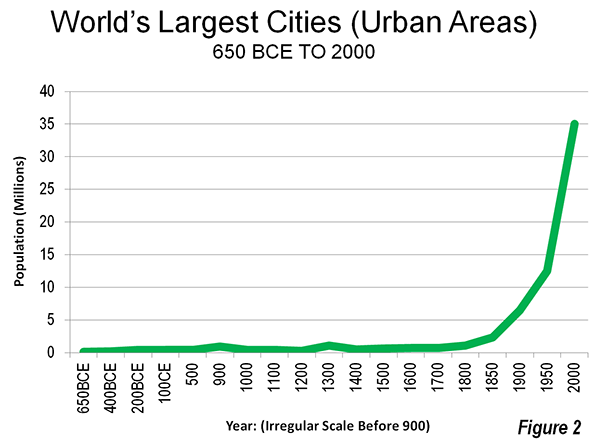
Between 1820 and 2010, the world population grew from 1.0 billion to 6.8 billion as indicated in the databases. This 550% increase, however, pales by comparison to the increase in the world real gross domestic product (GDP), which grew nearly 13 times as fast as the population (Figure 1). The relationship between rising urbanization and increasing wealth is evident in comparing Figure 1 to Figure 2 from the recent feature What is A Half-Urban World. Between 1820 and 1900, the real economic growth rate was 1.5 times of that of population growth. This improved to 2.2 times between 1900 and 1950. In each of these succeeding decades, the economic growth rate relative to population growth was even greater, except in the decade of the 1980s when economic growth was 1.9 times population growth. Despite the economic difficulties, particularly in Japan and the West, 2000 to 2010 showed the largest rate of economic growth compared to population growth, at 3.0.
GDP Per Capita (Purchasing Power)
The real GDP per capita data strongly indicates the expanding economic pie. In 1820, the world GDP per capita was approximately $1100, expressed in 2010$, adjusted for purchasing power. By 1900, this had nearly doubled to $2100. The largest gains came after 1950 when the GDP per capita reached $3500. Since that time the GDP per capita has risen to $12,200 (Figure 2).
A History of Poverty
Even so, the history of economics is a history of poverty. University of Rochester (NY) Economist stated the case this way:
Modern humans first emerged about 100,000 years ago. For the next 99,800 years or so, nothing happened. Well, not quite nothing. There were wars, political intrigue, the invention of agriculture – but none of that stuff had much effect on the quality of people’s lives. Almost everyone lived on the modern equivalent of $400 to $600 a year, just above the subsistence level.
The $1100 GDP per capita from 1820 would rank among the poorest areas in the world today. The world's richest area at that time was the Netherlands, which had a GDP per capita of $3100. This is more than Nigeria today, with its 143 million mobile phones and nearly as high as the GDP per capita of India.
Distribution of Income
Today, the large majority of the world's population lives in lower income areas.
  • 16% of the population lives in areas with a GDP per capita of less than $2500. The largest of these are Bangladesh and Tanzania.
  • 29% of the world's population is in areas with a GDP per capita of $2500 to $5000. The largest are India, Indonesia, Pakistan, Bangladesh, Nigeria and the Philippines.
  • 26% live in low middle income areas with a GDP per capita of between $5000 and $10,000, such as China and Ukraine.
  • 14% live higher middle income areas (a per capita GDP of $10,000 to $20,000). The largest such areas are Brazil, Mexico and Russia.
  • 10% of the population lives in relatively well off areas (a GDP per capita of $20,000 to $40,000) including France, the United Kingdom, Korea and Japan.
  • Only 5% of the world's population enjoys a GDP per capita exceeding $40,000, the largest of which are the United States, Germany, Canada and Australia. (Figure 3).
The Richest Areas
The very richest countries in the world on a per capita basis are generally small. Oil rich Qatar has the highest GDP per capita at nearly $100,000 annually. Europe's Luxemburg is the second most affluent, followed by the city-state of Singapore. Resource rich Brunei-Darassalam is the world's fifth richest area. The United States ranks sixth and is by far the largest of the richest areas. More than 55% of the world's population in areas with more than $40,000 GDP per capita lives in the United States. The balance of the richest 10 is completed by the United Arab Emirates, another oil rich Gulf state, the world's other large city-state, Hong Kong, as well as the Netherlands and Switzerland in Europe (Figure 4).
Generally, IMF data indicates that the largest high-income world economies have experienced real GDP per capita growth of from 40% to 80% since 1980. The UK has grown the most among the examples, while Italy has grown the least (Figure 5). Germany's lower growth rate is, at least in part, due to the complexity of combining virtually bankrupt East Germany with far healthier West Germany in the early 1990s. The US has been hobbled by its housing bubble-induced economic bust, which hurt other economies as well. Canada's recent stronger growth could presage an improved ranking in the years to come. Other areas, such Italy, Spain, Japan and France could experience slower growth in the future, due to the seemingly intractable fiscal difficulties and, in some cases, demographic stagnation or even decline.
Who’s Growing Rich Fastest?
A number of countries have experienced spectacular growth in their GDP per capita over the past three decades, according to the IMF data (Figure 6). Oil rich Equatorial Guinea experienced the greatest growth, reaching a GDP per capita more than 16 times the 1980s figure. Equatorial Guinea is small, with a population of only 700,000 people (similar to the size of metropolitan areas such as Colorado Springs, Colorado, Hamilton, Ontario or Florence, Italy).
The broadest and most significant progress has been made by China. According to the IMF data, in 1980 China had the second lowest GDP per capita of any reporting area, ranking above only Mozambique. This was approximately the same time that the economic reforms began, under the leadership of Deng Xiaoping. By 2010, China's GDP per capita had reached more than 12 times the 1980 figure. China's gross GDP-PPP grew more than that of any other area. Once on the low end of the poverty league table China now has entered the middle rank in terms of wealth.
Other areas have also done well, especially in Asia. The largest of these include Korea, Vietnam, Taiwan, Thailand and Singapore. One African area is included among the fastest growing per capita economies, Botswana (Figure 6). Each of these areas grew from four to five times in GDP per capita from 1980.
The Poorest Areas
All 10 of the world's poorest areas are located in Africa. The poorest is the Democratic Republic of the Congo, with a GDP per capita of less than $400. Torn by civil war its GDP per capita would rank it among the poorest areas even in the 1820 listing. The four next poorest areas have also faced severe domestic disruptions, Liberia, Zimbabwe, Burundi and Eritrea (Figure 7).
Some Areas Getting Poorer
The severity of the world's poverty is indicated by the fact that 26 of the 138 areas for which there is data experienced declines in their GDPs per capita from 1980. The population of these declining areas was about 300 million, or approximately four percent of the world’s total. The Democratic Republic of the Congo, the world's poorest area, experienced a 60% decline in real GDP per capita, which was the largest decline.
Conclusion
While the economic pie has expanded much faster than its population, there is still plenty of poverty in the world. It is no surprise that the developing world focused the attention of the recent 2012 Rio +20 conference on poverty, with a declaration that eradicating poverty is the greatest global challenge facing the world today.


Photo: Ojota, Lagos, Nigeria (by Seun Oyeniran)
Reposted with permission. Originally posted on http://www.newgeography.com by Wendell Cox 11/29/2012

Wendell Cox is a Visiting Professor, Conservatoire National des Arts et Metiers, Paris and the author of “War on the Dream: How Anti-Sprawl Policy Threatens the Quality of Life.”

Tuesday, November 13, 2012

Global Gender Gap Index

The Global Gender Gap Report 2012 benchmarks national gender gaps of 135 countries on economic, political, education- and health-based criteria. The Global Gender Gap Index was developed in 2006, partially to address the need for a consistent and comprehensive measure of gender equality that can track a country’s progress over time. The index points to potential role models by revealing those countries that – within their region or income group – are leaders in dividing resources more equitably between women and men than other countries, regardless of the overall level of resources available.

The Global Gender Gap Report 2012 emphasizes persisting gender gap divides across and within regions. Based on the seven years of data available for the 111 countries that have been part of the report since its inception, it finds that the majority of countries covered have made slow progress on closing gender gaps.

This year’s findings show that Iceland tops the overall rankings in The Global Gender Gap Index for the fourth consecutive year. Finland ranks in second position, overtaking Norway (third). Sweden remains in fourth position. Northern European countries dominate the top 10 with Ireland in the fifth position, Denmark (seventh) and Switzerland (10th). New Zealand (sixth), Philippines (eighth) and Nicaragua (ninth) complete the top 10.
The index continues to track the strong correlation between a country’s gender gap and its national competitiveness. Because women account for one-half of a country’s potential talent base, a nation’s competitiveness in the long term depends significantly on whether and how it educates and utilizes its women. 

Download the full Global Gender Gap Report (PDF) here or Country Gender Gap Highlights here

The full web page to this blogpost can also be found here

Wednesday, November 07, 2012

My Country, My Heart and My Prayers on My Birthday

Seun Oyeniran
Its been about 11months since I wrote on this blog and its about the same time since I deactivated my Facebook page. Facebook is extremely useful to me so I miss being there a lot and I miss writing on my blog too. However the 11months break was useful because it provided me ample opportunity to look into various other issue beckoning for my attention especially since I returned to Nigeria after my MSc degree in UK (so I didn't regret the social media break at all and I may go on a few more breaks before coming on back finally soon ;). Today is my birthday and I'm reviewing and evaluating how I've spent my 28years in life. Reviewing, yes, but thinking more - becoming more less asleep - and out of my very busy schedule I decide to make some time to scribble out these few lines; first to connect back with all of you my friends; to tell you that I'm well; and to share my heart on various issues that remain pressing since I returned back to my dear country.


Among the thousand and one issues ravaging my mind right now, my dear country, Nigeria, happens to be top on the list. Not only because I am a Nigerian, but because from my little travel across continents, I have come to see and appreciate how beautiful Nigeria is. Through these same trips, my heart has also been remarkably enlightened by the challenges we continue to face as a Nation. This is the core of my burden. I increasingly find it hard to understand how Nigeria's issues have become so terrible. I keep wondering how a country termed by a WIN-Gallup poll as the second most religious country in the World with 93% of the people tagging themselves as believers (second to Ghana at 96%) continue to rank high in corruption and her people continue to witnesses increasing poverty levels like that which has never been seen before. 

Source: http://www.transparency.org/country#NGA
My heart is worried that while many countries transformed the lots of their people, lifting them out of penury through the discovery of oil, this same process has resulted in worse condition for our people. Gelb (1988) in Ismail (2010) IMF working paper WP/10/103 finds that Ecuador, Iran, Nigeria and Trinidad and Tobago went through the Dutch disease, mainly due to a decline in Agriculture, over the first and second oil booms of 1972–81, while Algeria, Indonesia and Venezuela went through a strengthening of their non-oil tradables. Oil will continue to be a problem for Nigeria because the volatility of the supply-price nexus of the commodity in the international market that will continue to result in volatility and instability as Nigeria's economic indices and revenue generation is strongly connected to the export of oil. The need to focus not only on agriculture (through the agricultural transformation agenda), but also on other sectors such as manufacturing and services is now more important in a modern economy where every country has to maximize its comparative advantage in our globalizing world. Even the reforms that worked for countries like China has hit gridlock in Nigeria; our corrupt and ignorant nature being one of the major hinderances. While the Investment Climate and Enterprise Survey carried out by World Bank puts Nigeria in an in-between condition of hope with many underlying issues to be addressed and several reports testifying Nigeria's growth (in fact IMF 2011 Regional Annex estimates 7.4% growth for 2010), yet youth unemployment and lack of jobs sinks down this hope as it public and private sectors are greeted by a demographic progression that continues to elude the knowledge frame of those in positions of authority. Lack of key knowledge of Nigeria's demographic dynamics continue to manifest itself across various policy making institutions across the nation. For example, it has already been established that the causes of instability in certain states such as Nigeria is youth 'bulginess'. A British Council Next Generation report captures this quiet clearly pointing out the downside of not reaping the demographic dividend. The World Bank, in its "Doing Business Survey" that aims specifically to measure and track changes in regulations affecting 11 areas in the life cycle of a business identified that for starting a business, Nigeria ranked 119 (out of 185); dealing with construction permits, 88; getting electricity, 178; registering property, 182; getting credit, 23; protecting investor, 70; paying taxes, 155; trading across borders, 154; enforcing contracts, 98; and resolving insolvency, 105. Access to finance and infrastructure, especially power continue to cripple young, fledgling businesses and entrepreneurial capacities of Nigerian people.


The ongoing issues in the Niger Delta are equally complex. The problems are clearly too big to handle by one company alone, or even by a consortium of companies. The environmental issues should be addressed  with structured programmes implemented to eliminate the major gas flaring that has been part of the history of oil development in the delta region. Among other things, the success of the massive investments in gas liquefaction projects - the largest investments in Africa needs to be sustained. But the problems of revenue allocation and distribution, questions of law and order, the construction of infrastructure and the tensions between different ethnic groups in relation to electoral and local government areas need proper regional planning and local and national government intervention; probably through the NDDC.


How much can I say about the many burning issues in my heart as I continue to watch with utter dismay as our country continue to witness more bomb blasts. A situation that seems like an insurgency in 2009 in the north-eastern city of Maiduguri with rudimentary bombs and drive-by shootings; men on motorbikes targeted police and clergy has rapidly evolved, with suicide-bombing hitting among other notable places, the UN headquarters in Abuja, the capital, last August, killing 25 people. Suicide-bombings, barely known in west Africa until last year, are now the most potent weapon in many militia's arsenal. Same time last year November 2011 more than 100 people were killed in such bombings as well as in gun attacks. The effect of the insecurity in the country is becoming increasingly pronounced so much so that, even Transcorp Hilton, where in recent years getting a bed there has often been difficult at almost any price because doing business in Africa's most populous country was impossible without setting foot in one of the seven restaurants and bars nestled away in the hotel's two decade-old, concrete hull is witnessing major occupancy decline as as foreign companies have taken their business to Lagos, the commercial capital, and kidnap-prone Port Harcourt in the south. International airlines, who were long among the Hilton's best clients, no longer dare to keep crews in Abuja; British Airways, Lufthansa and Air France now either fly there and back with two crews on board, or have their flight attendants stay in Lagos or Accra, Ghana's capital.

But I know deep within me that a change will come, time will turn for Nigeria. Our MIFFS (middle-income fragile or failed states) profile will change. We will continue to keep close watch with how the $75 per barrel benchmarks feeds into the entire budgetary and allocation system. We will keep our contacts on how the Sovereign Wealth Fund (SWF) launched in May this year will impact the lives of all Nigerians. We will progressively monitor the SURE-P policy and match their comments and reports with impacts on education and infrastructure and the lives of ordinary people. We will keep up with evidence based policy initiatives through our research and work very hard to see to their appropriate implementation. We will keep our gaze on the demographic transition our country is witnessing and keep hoping it tilts to produce dividends rather than disaster. We need to move away from ethnic lines and connect with one another in sincere honest ways. Development indicators must start to favour us as a nation.  And should I break this down further by adding that we need to develop a learning culture, rather than a copying culture. Our growth will remain unsustainable as long as we fail to understand what the key ingredients of nation building is all about. The patience to learn processes and procedures and the intent to follow due process should improve. We need to develop the capacity to be slow to talk but more to listen and learn. We need to check how things are been done and develop the capacity to learn. Someone recently retorted: "what do we have to learn about the hurricane Sandy and the elections both taking place in the US?" A question I think requires a urgent response. Economic theories and principle may work elsewhere but we need to understand our Nigerian context and develop strategies to implement growth initiatives that will bring about emancipation for all Nigerian people.

The family units in Nigeria must continue to work harder because it still remains the fundamental institution where values are imparted. And I strongly believe this unit is still the only tool for transforming our nation as more empirical evidences are emerging that shows us that we can tackle both the economic outcomes of the young people as well as reduce poverty tremendously if we continue to sustain good family life (Aleshina and Giuliano, 2010; Krishnan, 1996; Lam and Schoeni, 1993). The Economist recently reported that Quamrul Ashraf, David Weil and Joshua Wilde estimated that a decrease in Nigeria’s fertility rate by one child per woman would boost GDP per head by 13% over 20 years, with almost all the gains coming from the “dependency effect” of there being fewer children to look after.
I see Hope in these Primary School Students
I'm Currently working on a Library Project for them

We must continue to show indomitable courage and resilience despite our many challenges.  We must continue to seek knowledge. Our reading culture also needs to improve. I particularly recommend these two books I just finished reading: Son of Hamas and Confession of an Economic Hitman; which both shed light on fundamental issues affecting our nation but with deep spiritual inclination. Our Church model needs an overhaul, we are doing more gathering and less of shinning as our master commands us. Yes Nigeria is the second most religious, but its more than religion. We must shine; in the dark places, not in the already 'lighted' places. We must pray, not for our needs alone, but for a healing for our nation. As I continue to discuss with top academics and scholars about our many issues in Nigeria, trying to gather points of solution and to chart a way forward for our country, many of them propose bloodshed and killings. But I refuse to agree with them. I have come today to re-affirm that prayers can work and it will work for Nigeria. Its a call to prayer and it starts with me, you and everyone of us.  Its a sober time for us all that requires our heart to be open to our creator.

I can't end without saying how grateful I am to God the Father, Jesus his son and the Holy Spirit my teacher, comforter and closest companion. And to my very own, Channon, I love you so very much. Very many thanks to family,  friends and associates and networks. I'm now even more convinced that God has a lot to do with us than ever before. Lets keep on with the master.


References
AfDB ,  OECD ,  UNDP   and UNECA   (2012) : "African Economic Outlook 2012: Promoting Youth Employment",  African Economic Outlook.

Where will the world’s poor live? Global poverty projections for 2020 and 2030 (http://www.ids.ac.uk/files/dmfile/InFocus26-Final2.pdf) ". Institute of Development Studies "Where do the world’s poor live? A new update (http://www.ids.ac.uk/idspublication/where-do-the-world-s-poor-live-a-new-update) ". By Andrew Sumner. Institute of Development Studies

"Horizon 2025 (http://www.odi.org.uk/resources/docs/7723.pdf) ". By Homi Kharas and Andrew Rogerson. Overseas Development Institute 


British Council and Harvard School of Public Health Nigeria The Next Generation Report


Alesina A. and P. Giuliano (2010), The power of the family, J Econ Growth 15:93–125

Krishnan, Pramila   (1996) : "Family Background, Education and Employment in Urban Ethiopia",  Oxford Bulletin of Economics and Statistics, 58, 167-183.

Lam, D. and Schoeni, R. F. (1993). 'Effects of Family Background on Earnings and Returns to Schooling: Evidence from Brazil', Journal of Political Economy, Vol. 101, No. 4, pp. 711-37.

WIN-Gallup International, Global Index Of Religiosity And Atheism (2012), available <http://www.wingia.com/web/files/news/14/file/14.pdf>, accessed 6/11/2012

Alan Gelb and associates, Oil Windfalls: Blessing or Curse? (Oxford University Press, for the World Bank, New York, etc.. 1988) pp. 357.

Bello, Steven Tairu   (2005) : "A Comparative Analysis of Chinese-Nigerian Economic Reforms and Development Experiences",  China and World Economy, 13, 114-121.

Downie, R., and Cooke J.G., (2011),’ Assessing Risk and Stability in Sub-Saharan Africa’, Centre for Strategic and International Studies, Africa Programme (June)

World Development Report 2013