Showing posts with label Emerging Economies. Show all posts

Sunday, April 27, 2014

Africans, don't give up on Africa

Although my wife is Canadian because she was born here; her ancestral roots traces back to the West Indies and ultimately Africa. My wife studying history and eventually furthering in Modern Slavery make both of us a team for Africa emancipation. If we're not talking about promoting African values in our Canadian context, we are busy putting the lines together about Africa: the news, reports, economic analysis, the society, environment etc. So when she sent me an email containing a link to the set of pictures below during one of her research, I wasn't at all surprised. The pictures were published on CNN’s Inside Africa website with the caption: “Stunning photos show Africa through African eyes”. The publication was part of the the IBM Research Africa 12 Global Research Lab Project

My wife naturally connected with the stories that followed each picture because of her education and of course the many trips we have made together into Africa and African related attraction around the world. For me, however, I connected with those pictures because I saw myself in them. They told my story.

photo 3 photo 1
The house I was born in Mushin Lagos, Nigeria was just across the railway line like this. Since I was born  up till date, I’ve never seen a single train pass through. My parents never stop telling tales of how busy that railway line used to be. Yet in other places, trains are working. Railway workers strike and others leave the few working ones over crowded like the one seen above.
photo 2 photo 4
We fetched water like this. I remember lifting big buckets on my head on very long distances. And you just have to fill up those big drums stored behind the kitchen doors. Africans are extremely creative. We make something out of nothing. Don’t pity Africa, work with Africa! We have a thriving creative economy, youth bulginess.
photo 3 photo 1
Yet we have hope. The future is not ahead, the future is now. When I was a kid we soil ourselves like this young child, telling ourselves we are eating food as we put this dusts on our chin. We have not lost hope. Its this hand-in-soil that has strengthened our creativity. They say religion has been our bane. But who could I have been if I had not known the Lord Jesus Christ. Because of our faith our communities are built on tenets of respect and love. Its this foundation that allows people like myself to thrive all around the world.
photo 2 photo 4
While many people know this young boy made a pair of “glasses”, only very few people knew what he made it of and what the process of making it require. I know because that boy was just exactly like me! we made those funny looking pair of “glasses” out of table-top calendar spine. Creativity is in our DNA! This is Africa!! This picture passed the strongest message to me. What are we doing to secure the future? Or better still, what am I doing? I see Bill Gates and his earnest effort and I say to myself yes, this is the way to go! We have to secure the health of our future generations.


This is Africa. We are Africans. If we have come this far why go back? Our faith has been strengthened because daily, we face challenges that forces us to exercise them. We have experienced mountain moving faith as we see mountains of poverty and economic hardship sublime. We are hard working and we also believe in honest dealings even though corruption is fast making this assertion an illusion. We have grown because we strengthened our communities by caring for one another in a most unique way. These is Africa, where you can have breakfast, lunch and dinner in the house of three different people you met on the street. We take care of our own, we don’t let one another down. This is the Africa I have grown into from the 1980s into the 2000s. All the evil that has happened in recent times must be be reversed. We will not sit and look at them take away our glorious future. We will reverse it. We will fight it with our words across the diaspora.

We are not where we want to be, yet, we are not where we used to be. The road is still very far. We must not allow idiosyncratic people who have crept into our communities deny us of our glorious destination. We must not fail to connect with our core competences, build on our strength and secure future generations. I personally don’t expect a sudden change but one thing I’m sure of is that: myself and many others who share similar vision will not give up. Africa will arise to take its rightful place among committee of nations. It has already begin to happen, the chart below shows Nigeria is the 3rd fastest growing economy in 2014 and hence a major destination for investment (Wealth Professionals Magazine Issue 2.2 pp8,14). By 2050, global economic dynamics would also have shifted in Africa’s favour. Keep in mind that this are assumptions and pre-included are very high risks factors. If we continue to work on reducing these risk factors: ensure political stability, a stable society, we can exceed these growth estimates by very wide margin.

image

image

Its time Africa, We must not give up!

Wednesday, January 01, 2014

Nigeria in 2014: The African telecommunication sector will grow and quality is expected to improve in Nigeria


Part of research conducted by Informa Telecoms & Media, entitled: Africa Telecoms Outlook 2014: Maximising digital service opportunities, identifies mobile broadband and the increase in global connectivity as key drivers behind this projected growth. According to statistics revealed in the research, there were 778 million mobile subscriptions in Africa by end June 2013 and the expectation is that the mobile-subscription count will reach one billion during 2015. Contrary to what is being experienced in other regions, in Africa mobile voice revenues are expected to grow over the next few years. The research adds that annual mobile data revenues on the continent are expected to rise from US$8.53 billion in 2012 to US$23.16 billion in 2018. Data accounted for 14.3% of mobile service revenues in Africa in 2012 but will account for 26.8% in 2018. “The growth in data revenues in Africa is being driven by factors including: the continent’s new submarine and terrestrial cables; the rollout of mobile broadband networks; the increasing affordability of data devices; and economic growth. As well as facilitating a rise in data connectivity in Africa, these factors are creating a platform for a range of new digital services on the continent, such as mobile financial services, e-commerce and digital content and services for the business market,” states an excerpt from the study. In an article on BizTech Africa, Nigeria govt talks tough over service quality, Minister of Communications Technology, disclosed at media parley with senior journalists, said the Ministry of Communication Technology, the Consumer Protection of Nigeria (CPN) and the regulator, the Nigerian Communications Commission (NCC) are collaborating to sanction or prosecute erring telecoms operators that have been delivering poor quality service to Nigerians. The Minister said “the Federal Government will no longer condone poor service delivery to subscribers and reiterated that henceforth, it’s no longer shall be business as usual, and operators must rise up to redress the current poor state of quality service delivery.” Another related development is the reduction in the cost of Right of Ways (RoW) in certain states in the country which will facilitate the roll-out of telecoms infrastructure in the country. Association of Licensed Telecoms Operators of Nigeria (ALTON) identified that this reduction would definitely impact on telecoms service delivery. It will be interesting to keep tab on events as they unfold in 2014.

Read the full article here: 10 Economic Highlights to look out for in Nigeria in 2014. Want to share you thoughts on the Nigerian Economy in 2014? You can drop your comment below or continue the discussion with on twitter 

reference list

Nigeria in 2014: e-Commerce will take centre stage

This is very related to the above point on Mobile payment and transactions. On 16th December 2013 German e-commerce incubator and cloning giant Rocket Internet, MTN, Africa’s largest cellphone operator and Stockholm-listed Millicom International Cellular partnered to develop internet e-commerce businesses in Africa through Africa Internet Holding (AIH), a vehicle to develop e-commerce businesses across the African continent (alongside partner Millicom International Cellular). They each took a 33.3% stake but the value was undisclosed. While still subject to regulatory approval, the parties expect the transaction to close during the second quarter of 2014. The implication for Nigeria? More transaction will be fulfilled online and there will be a radical change from the traditional brick and mortar shopping to shopping online as seen in developed countries. Businesses will have to respond by developing B2C and B2B enterprise architecture that will facilitate e-commerce. AIH has already developed a number of e-commerce ventures in the last 18 months, including Jumia, Zando, Kaymu, Jovago, Lamudi, Carmudi, EasyTaxi and Hellofood. The partnership is expected to capture the growth potential of the digital media space across footprints in the region.

Read the full article here: 10 Economic Highlights to look out for in Nigeria in 2014. Want to share you thoughts on the Nigerian Economy in 2014? You can drop your comment below or continue the discussion with on twitter 

reference list

Thursday, October 27, 2011

RE: Can Nigeria Outstrip Italy and Canada?

Global Disparity and the Convergence Theory

As my last post "Can Nigeria Outstrip Italy and Canada?" (2/7/2011) raise discussions and debate across boards, I try in this post to put forward responses to the many ongoing but underground discussions that the article generated. While most of the reaction (especially by Nigerians) to the question under discussion tilted towards the negative gradient (meaning that Nigeria outstripping Italy and Canada in economic term is not possible), many others hold the resolve that it can happen, Nigeria can outstrip Italy and Canada. The pessimist have valid points to justify their stand based on the obvious economic doldrums that Nigeria is at the moment - climaxed on the Boko Haram issues, the optimist have their justifications too albeit divided into two categories. Some Nigerians are "religiously" optimistic for a better tomorrow while others take a more tacit approach to their resolve that Nigeria will be better. I belong to the positive religious tacit optimist of Nigerians who seem to apply strong spiritual and academic understandings without necessarily doing that in a show-off manner. Not that the obvious is not imminent: that Nigeria is a country stacked between abundance and poverty, its just that I and many other optimistic Africans believe that once we get the leadership crisis resolved (i.e. the right mix), we can make radical progress. We can not, however, isolate the overarching power of a divine God in achieving the progress that we so dream of (see my previous posts here)
Yes, if we Nigerians do away with CORUPTION! It's in habit of all. We need God's divine visitation. God bless Nigeria with listening and God fearing leaders and follower. (Oyeniyi Ayodeji Oyedotun)
Global Disparity| Looking beyond Africa (Nigeria), we see a global disparity that has taken shape in the last three decades. Many countries that were thought to be economically advanced and "stable" have witnessed huge economic crisis that has shake their policies to the roots. Its interesting what is happening globally today. Although coming at the cost of war and conflicts, many African countries (and other developing and emerging economies) are consolidating their democracies and putting in place many policies and reforms that will entrench sustainable growth and development. Contrary to what is happening in Africa, the recent downgrading of America's Investment Rating from AAA to AA+ for the first time since 1941 by the Standards & Poor's should paint a better picture of the direction in which growth in take in the global space in subsequent decades to come. It is important to also mention that the recent upheaval against Wall Street (Occupy Wall Street) shows that times are truly changing a phenomenon some call response to "Corporate Greed". These developments fits neatly with the struggle to recover from deficits in many European countries leading to many European government budget cuts and resulting in the worst ever protest and street rioting all of which should make us understand that there is tendency for multinationals to begin to look into Africa for business purposes. In fact countries like UK and USA that have delayed their moves to spread their businesses to Africa are already beginning to reap the brunt of their inactions. Lets take a vivid look at the disparity in a chat I present below.


In 2007, real GDP growth rates for emerging/developing economy was 8.7% when compared with 2.6% for advanced economies. Despite the fact that both regions’ growth rate declined, it remained at 6.5% and 2.3% for emerging and developing economies and advanced countries respectively in 2011. The disparity lingers on to the present since it started from the year 2000.

Another way the global disparity is seen is the case where certain countries such as Nigeria which are endowed with high population are coming higher up the matrix when interpolated nominal GDP. This is illustrated below.
The Convergence Theory | We can use the convergence theory to partly justify the stand that Nigeria can outstrip Canada and Italy. Its a simple economic theory that combines some aspects of endogenous and exogenous growth theories. The idea of convergence in economics (also sometimes known as the catch-up effect) is the hypothesis that poorer economies' per capita incomes will tend to grow at faster rates than richer economies which will be witnessing what Robert Solow called "steady state". Consequently, what we now see will be a resultant: both emerging/developing economies (BRICS+N-11 Nigeria inlcusive)  and the advanced economies should eventually converge in terms of per capita income. Developing countries have the potential to grow at a faster rate than developed countries because diminishing returns (in particular, to reproducible capital) are not as strong as in capital rich countries. Furthermore, poorer countries can replicate production methodologies, technologies and institutions currently used in developed countries making them achieve quicker growth rate within a short time.
The essentially of good operational environment is inevitable as we call for peace across the African continent. A social externality cost is incurred and recipe for disaster guaranteed when young people lack skills that can lead to gainful employment due to poor education funding especially in highly populated countries. Hence we call for more funding for education. Needless to say that funding education will lead to production of entrepreneurs who will ultimately stimulate wealth and income creation and a further growth in agricultural and service sector will ensue due to persistent technical progress. 

My answer to the question remains a yes, Nigeria can!

Seun Oyeniran.

Saturday, July 02, 2011

Can Nigeria Outstrip Italy and Canada?

As I start my MSc dissertation this week, I keep jumping into several details that excites and fascinates me. I know the caption above may sound very controversial, but that's just how journalists are beginning to ask the Goldman Sachs team. Its not just the question in itself that seem interesting, the mere fact that  these questions can be asked is a testament to the shift in the global economy and it makes me sit down and press forward to focus my [re]search light on this area. And I think I will be talking about this a bit more for weeks to come. 

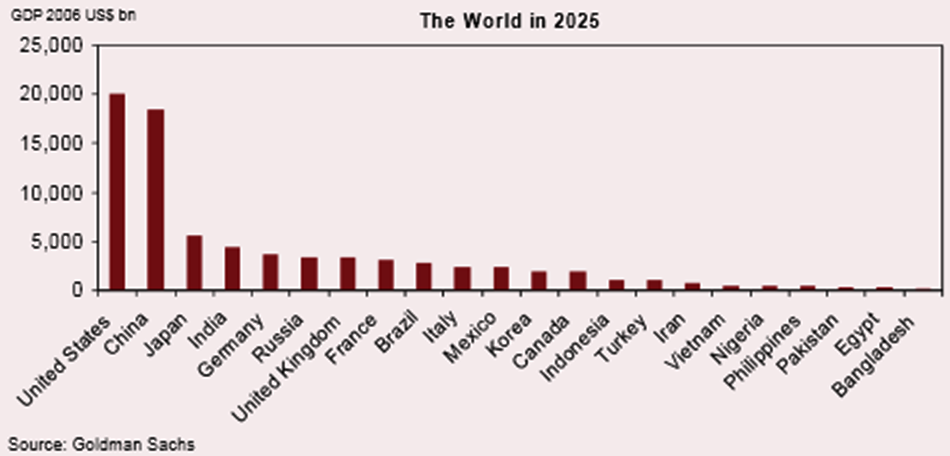
Whether or not the Nigeria's vision 20/2020 dream is built on this postulation is not so clear but materials available at the National Planning Commission office show some elements of Goldman Sachs Report on N-11 which I have discussed briefly on my previous post on this blog. The N-11 term is more than an acronym, it is a distinct group of countries in itself, albeit one defined by population. Following the BRICs (Brazil, Russia, India, China) are the N-11 which includes: Bangladesh, Egypt, Indonesia, Iran, Korea, Mexico, Nigeria, Pakistan, Philippines, Turkey and Vietnam. Mainstream economic growth theories put forward by Adam Smith and Alfred Marshal have pointed out that labour and capital are two fundamental variables that can propel a country's productivity. Other neoclasical economists have extended this aspect of labour to include particularly human capital. It is thus expected that a country with high population will have a high growth potential (i.e. GDP). Inadvertently, if we agree with both classical, neoclassical and modern theorist, Nigeria as a country can leverage it vast human capital resources and youthful population to foster economic growth and development (remember 'demographic dividends' and youth 'bulginess' from previous posts?). Building up on stories of gloom for Nigeria being as a failed state (as put in some recent publication with questionable sources), we are once again faced with reports of hope. Whether they are forecasts targets or estimates, the Nigerian government is seen to align in this positive direction of making the future brighter than the past.
 "One of the most remarkable phenomena of the past couple of years is just how enthusiastic the leaders of some of the N-11 countries seem to be about changing policies and wanting to engage in globalization. Nigeria is one country that deserves special mention, and is certainly a country that has captured my attention. With a population close to three times that of South Africa, Nigeria's ability to deliver on our 'dream' could be vital for the whole African continent" Jim O'Neill (November 23, 2007)
Nigeria has the scale to be important in global economies if it can deliver sustained growth. Although not very popular like other N-11 countries e.g. Korea and Mexico, but it is precisely this uncertainty and the fact that Nigeria lie well off the radar screens that makes it so intriguing. If Nigeria defy skeptics and take concrete steps towards addressing areas of weakness, her growth could be much higher. Certainly, improving global conditions while the global backdrop is benign is likely to offer the best chance of weathering the next storm.

So the question of whether Nigeria can outstrip Italy and Canada has already be shown to be possible in the  figures above showing GDP estimates in 2050.These forecasts are subject to inaccuracies caused largely by variable that were not considered prime of which is the climate change. While that is a global perspective, How we handle our systemic issues (i.e. violence, crime, corruption, political stability, etc) as a nation will determine to a large extent where we will be in the nearest future. I will be dedicating the next few weeks to considering factors that may or may not make us achieve first the vision 2020 targets as well as the N-11 vision 2025 and then 2050.

However, just as someone was asking me after my presentation on Nollywood in Lancaster, UK whether it was a 'Good People, Great Nation' propaganda I was doing for...you know ([laughs]), I want to answer a similar question headlong: these blog posts are not for propaganda or to put a government in a good light or otherwise. Although they carry element of good will to both the people and the government of Nigeria, they are purely academic and aimed at stirring further research and discussion. 

Seun Oyeniran.


References
Downloads . (n.d.). NIGERIA NPC - National Planning Commission | National Planning Commission Offices . Retrieved July 1, 2011, from http://www.npc.gov.ng/home/doc.aspx?mCatID=68253

Goldman Sachs | BRICs. (n.d.). Goldman Sachs. Retrieved July 1, 2011, from http://www2.goldmansachs.com/ideas/brics/index.html

Saturday, May 14, 2011

Repositioning Nigeria's Position

As I look through the media recently I pick a wave of interesting facts. What actually stirred my quest was the outcry against the war in Iraq shown in an IVAR video on facebook. As I dig deeper I realized that most war have direct or indirect economic implications and quite interestingly Nigeria is at the core of all the issues raised. Why I eventually decided to write this piece is to throw more light on the critical need for us to move our attention off crude oil and reposition ourselves as a country, to what our fore fathers handed down to us during our independence, a culture of hard work and creativity.

‘Depression 2.0’: March towards 2050, The Period of abundant oil opportunity or Misery
More than ever before the myth that crude oil production is increasingly diminishing is now hitting the world like never before. The industrial doomsday scenario put forward by peak oil theorists isn't just for far flung voices on the Internet anymore. A term shell itself (the second largest company in the world) call ‘Depression 2.0’. Not that crude oil reserves all over the world is running out, in fact the world has enough to sustain energy, productivity and growth globally, the critical issue lies fundamentally in the fact that it is becoming very expensive for firms to afford its mining and processing which on their own attract tremendous oil usage. Apart from the critical link oil has with many of the recent war that truncated global peace, the adverse effect of oil to the economy and society is obvious. The growing volatility of oil prices together with the externality it creates such as global warming, human right violation, pollution, blocking of alternative energy sources and in our own Nigeria context, corruption should make us think of alternative economic engines that crude oil. As the demand for oil buts up against actual production and remaining reserves, the climbing price of oil will cause the gross domestic product of all nations to decline.

Crude oil or Palm oil: A dire need to diversify our economy


The figure above is from one of my recent presentation on Nigeria’s Creative Economy. It’s obvious that while crude oil production fell between 2006-2008, the value and share of creative goods exported (and produced) by Nigeria increased. It was interesting to note that income per capita also increased as returns from oil dwindled. This is a practical exhibit to prove that earnings from our local production capacities has the ability to propel growth that envisaged in previous years. Yes, we have crude oil, God blessed us with it. But going by the recent trends, it is becoming increasingly obvious that an economy that solely depends on crude oil production is as volatile as the prices of the crude oil itself. While Libya’s issue has caused Nigeria, UAE and Kuwait to jack up our daily production quota, we may benefit from the oil boom. However, this may prove contrary to the countercyclical domestic demand policy that proved useful for Nigeria during the time of depression in 2008/2009. What helped us then, when prices of oil fell was the fact that our agricultural sector and other domestic creative capacities especially within the West-African sub-region helped cushion the effect. We should not lose focus of these benefits in the face of the recent sudden rise sudden hike in OPEC crude oil prices to distract us from the need to pay attention on diversifying the economy. From my research on agriculture, palm oil, one of our main produce in the 60s and 70s has the capacity to produce jobs quite dynamically to eradicate poverty than crude oil would do. The non-oil Sector is the way forward after the elections. Most developed countries are willing to seek cheaper source of raw material input for their industries, the more reason why China is becoming very popular.

Let me try to keep this short from here as I conclude. Nigeria’s GDP was remarkable in 2010 at $207 billion or $2,400 per capita on a purchasing power parity basis, with real growth of 6.8 percent. The International Monetary Fund's World Economic Outlook predicts GDP will increase 7 percent in 2011. What this means to a lay man is that the total value of goods and services produced in Nigeria in 2010 was higher than that of 2009 and this trend is projected to increase in 2011. In fact by 2012, it is expected that Nigeria’s GDP would exceed South Africa (which is currently Africa’s leeding economy). Achieving vision 20/2020 seem sceptical and more pessimistic is to assume that we can’t achieve it, but it’s clear that the economic records of 2010 hinges upon internal domestic activities and policies that strengthened local production capacity. Many of the foreign reserves (down by 23% from 2009) are been depleted to fund infrastructural projects, which is reasonable in my personal opinion as long as those infrastructural project will continue to yield increasing domestic factor productivity and attract FDI into Nigeria. Consolidating democracy as seen in the recent April election, building on the banking and financial sector reform so as to make credit available for local entrepreneral engagements as seen in the ‘AMCON to NPL buy-offs’, building on gains from telecommunication and linking them directly with the financial systems and implementing plans for the energy reform will go a long way in 2011 and vision 20/2020 in general. In fact, the Nigerian Stock Exchange All Share index closed on April 18 at 25,429, up 1.6 percent. It is up 2.7 percent since the end of 2010.

As I go on to carry out further research on Nigerian non-oil sector and its implication for sustainable economic growth and development, some other seemingly important issue is burning in my mind. We needs to address this urgently and it has to do directly with how the Nigerian parents are bringing up their young ones. We need to consider if the idea that ‘my children must not suffer what I suffered’ is actually a good idea for our society. Maybe it’s a slogan that has allowed corruption to thrive and the resultant drop in quality and work ethics in Nigeria, especially among the youths.

Seun Oyeniran

Reference

Tuesday, March 22, 2011

What the Elections Hold For Nigeria: Gloom or Glory (An Economist View)

From the greatest of economic optimism to the highest forecast of gloom, Nigeria is always tossed in between when looked through the knowledge prism of intellectuals around the globe. Global Trend 2025 Report forecast Nigeria to be part of the ‘arc of instability’ due to its youthful age structure and rapidly growing population. This ‘youth bulge’ is expected to remain on rapid growth trajectories and according to this report, unemployment conditions must change ‘dramatically’ to avert instability and state failure. This report holds element of truth, but there is greater optimism. My personal findings working with young people in Nigeria and been a youth myself in my mid-twenties, I have come to understand more fundamentally that the youth, as much as they hold the ability to ruin the nation as seen in the case of Niger Delta militias, they also have the capacity to transform the Nigerian economy. A phenomenon I call the ‘Y-index’ (i.e. youth index). Another intellectual, Okonjo Iweala calls it ‘demographic dividends’. Together with growing technology in the area of telecommunication and the Nigerian Banking reforms (see figure below), the impact the telecoms industry is playing in the banking sector is now so obvious. This provides a bouyant financial sector for core economic activity. Nigeria is on its pathway to growth and that is more so now than ever before. Approaching elections, due in April 2011 (couple of weeks time), is likely to usher in a period of political instability that will probably see a significant increase in political tension. This is the opinion of a school of thought,but on the other hand, we as a nation have become wiser, thus this political tension can be averted or at least minimized in order for Nigeria to attain the required economic growth as a nation. Again, the youth has arole to play in achieving this. Economic expansion will be buoyed by robust performance in the non-oil sector. Real GDP growth is expected to average over 6.5% in 2011-15, provided political tension do not alter these forecasts, Nigeria can be seen to be on its path to economic glory.

Looking Beyond the BRICS: Nigeria, Among the Emerging Emerging Markets 'Frontiers'
Key Data: GDP growth: 5.8%, GDP: $248bn (PPP: $397bn), Inflation: 11.2%, Population: 155.2m, GDP per head: $1,600 (PPP: $2,560).

The biggest concentration of overlooked markets is in Africa (which is in many ways an overlooked continent). In 2011, according to The Economist (2010), there will be a great deal about the unexpected merits of ‘frontier’ economies such as Nigeria who are poorer and riskier than the emerging BRICS (Brazil, Russia, India and China). Multinationals intending to invest in foreign countries will be wise to do so now in order to enjoy location economies while leveraging the valuable skills in Nigeria to increase profitability and profit growth. Based on my recent work, I'll recommend two major non-oil sectors for profitable investment: Agricultural sector and the film industry (Nollywood).
Although with very high volatility, moving into Nigeria can provide a foreign company the needed vitality. Companies that move first will enjoy lots of advantages. They will be able to forge deals with aggressive young companies, strike infrastructure deals with local governments. And they can shape the tastes of future consumers. Companies that succeed in these neglected emerging markets are not only putting down roots in the world’s most fertile soil. They are giving themselves a chance to establish business habits (learning experiences/curves) for years to come. Many reforms are on-going in Nigeria and many is still to come. After all, there are hardly easy markets.

Seun Oyeniran


Reference
The Economist (2010), Businesses will learn to look beyond the BRICs, Nov 22nd 2010 | from The World In 2011 print edition (http://www.economist.com/node/17493411?story_id=17493411)
Hill, C.W.L., (2011), International Business: Competing in the Global Market Place, New York: Mc Graw-Hill
Global Trends 2025, (November 2008), A Transformed World,
UNCTAD Report, http://unctadstat.unctad.org/TableViewer/tableView.aspx?ReportId=719
CORRUPTION PERCEPTIONS INDEX 2010 , accessed 3/3/2011
Human Development Report 2010, The Real Wealth of Nations:Pathways to Human Development, UNDP 2010, accessed 3/3/2011
United Nations (2004), Conference on Trade and Development , Eleventh session São Paulo, 13–18 June 2004, GE.04-51545
Sloman, J. , and Wright, A., (2009), Economics, England: Pearson
Saugato Datta, (2011) (Eds), Economics: Making Sense of the Modern Economy, London: Profile Books