Saturday, May 11, 2013

Leading From Within - Video on integral leadership for sustainable development in West Africa-Nigeria

As I continue taking on more research works, and my quest to proffer sustainable options for economic development in emerging economies, West Africa and Nigeria in particular, I stumbled on thisOne Sky video via IDRC partnership programmes.  Its a video that looks at leadership for sustainable development from a very different but significant point of view i.e. integral leadership. It found very insightful and I'm sure you will too! This 27min video explores One Sky's integral leadership program in South-South Nigeria, entitled Leading From Within


"Thirty participants explore issues like HIV/AIDS, climate change, rainforest conservation, governance, widow's rights and youth empowerment in the context of leadership development. The three-year program, involving 30 participants and a dozen facilitators from several different countries, was designed with an integral approach in terms of curriculum, pedagogy, coaching, and program design. The program resulted in seven Breakthrough Initiatives and the formation of the African Integral Development Network. The video may be of particular interest to development practitioners interested in integral theory and psycho-social models of leadership development, however it does not require prior knowledge of the integral model. Includes scenes of village life in Nigeria, including ceremonies with chiefs and traditional songs with women, and also gives the viewer a felt-sense of how the Nigerian leaders in One Sky's program are making sustainable changes throughout the South-East corner of this country. Note to educators: this would be an excellent resource for university, college or even high school students"
One Sky welcomes comments and feedback.

Saturday, December 01, 2012

The Expanding Economic Pie & Grinding Poverty


A review of data from the past 200 years indicates not only a huge increase in the world's population, but an even more significant increase in real incomes. This is illustrated using the data series developed by the late Angus Maddison of the Organization for Economic Cooperation and Development that included historic estimates of economic performance by geographical area (nations and other reported geographies) from 1500 to 2000. The Maddison data is expressed in international dollars adjusted for purchasing power, so that the impact of inflation and differing prices is factored out, to the extent feasible. Caution is required, however, because there are difficulties with longer term purchasing power and inflation time-series, not least because technological advances make it nearly impossible to accurately account for the changed standard of living. For example, there were no telephones of any sort in 1820, yet today, low-income Nigeria has 143 million mobile phones, nearly 90 for every 100 persons.

I extended the Maddison data for another 10 years, to 2010, using the database of the International Monetary Fund (IMF) and converted all data to 2010 inflation adjusted international dollars.
Fast Population Growth and Faster Economic Growth
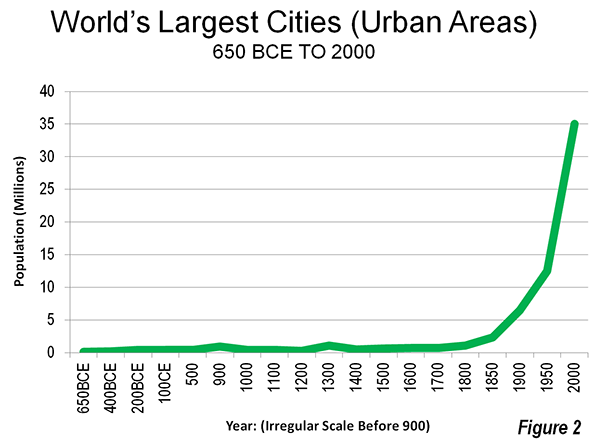
Between 1820 and 2010, the world population grew from 1.0 billion to 6.8 billion as indicated in the databases. This 550% increase, however, pales by comparison to the increase in the world real gross domestic product (GDP), which grew nearly 13 times as fast as the population (Figure 1). The relationship between rising urbanization and increasing wealth is evident in comparing Figure 1 to Figure 2 from the recent feature What is A Half-Urban World. Between 1820 and 1900, the real economic growth rate was 1.5 times of that of population growth. This improved to 2.2 times between 1900 and 1950. In each of these succeeding decades, the economic growth rate relative to population growth was even greater, except in the decade of the 1980s when economic growth was 1.9 times population growth. Despite the economic difficulties, particularly in Japan and the West, 2000 to 2010 showed the largest rate of economic growth compared to population growth, at 3.0.
GDP Per Capita (Purchasing Power)
The real GDP per capita data strongly indicates the expanding economic pie. In 1820, the world GDP per capita was approximately $1100, expressed in 2010$, adjusted for purchasing power. By 1900, this had nearly doubled to $2100. The largest gains came after 1950 when the GDP per capita reached $3500. Since that time the GDP per capita has risen to $12,200 (Figure 2).
A History of Poverty
Even so, the history of economics is a history of poverty. University of Rochester (NY) Economist stated the case this way:
Modern humans first emerged about 100,000 years ago. For the next 99,800 years or so, nothing happened. Well, not quite nothing. There were wars, political intrigue, the invention of agriculture – but none of that stuff had much effect on the quality of people’s lives. Almost everyone lived on the modern equivalent of $400 to $600 a year, just above the subsistence level.
The $1100 GDP per capita from 1820 would rank among the poorest areas in the world today. The world's richest area at that time was the Netherlands, which had a GDP per capita of $3100. This is more than Nigeria today, with its 143 million mobile phones and nearly as high as the GDP per capita of India.
Distribution of Income
Today, the large majority of the world's population lives in lower income areas.
  • 16% of the population lives in areas with a GDP per capita of less than $2500. The largest of these are Bangladesh and Tanzania.
  • 29% of the world's population is in areas with a GDP per capita of $2500 to $5000. The largest are India, Indonesia, Pakistan, Bangladesh, Nigeria and the Philippines.
  • 26% live in low middle income areas with a GDP per capita of between $5000 and $10,000, such as China and Ukraine.
  • 14% live higher middle income areas (a per capita GDP of $10,000 to $20,000). The largest such areas are Brazil, Mexico and Russia.
  • 10% of the population lives in relatively well off areas (a GDP per capita of $20,000 to $40,000) including France, the United Kingdom, Korea and Japan.
  • Only 5% of the world's population enjoys a GDP per capita exceeding $40,000, the largest of which are the United States, Germany, Canada and Australia. (Figure 3).
The Richest Areas
The very richest countries in the world on a per capita basis are generally small. Oil rich Qatar has the highest GDP per capita at nearly $100,000 annually. Europe's Luxemburg is the second most affluent, followed by the city-state of Singapore. Resource rich Brunei-Darassalam is the world's fifth richest area. The United States ranks sixth and is by far the largest of the richest areas. More than 55% of the world's population in areas with more than $40,000 GDP per capita lives in the United States. The balance of the richest 10 is completed by the United Arab Emirates, another oil rich Gulf state, the world's other large city-state, Hong Kong, as well as the Netherlands and Switzerland in Europe (Figure 4).
Generally, IMF data indicates that the largest high-income world economies have experienced real GDP per capita growth of from 40% to 80% since 1980. The UK has grown the most among the examples, while Italy has grown the least (Figure 5). Germany's lower growth rate is, at least in part, due to the complexity of combining virtually bankrupt East Germany with far healthier West Germany in the early 1990s. The US has been hobbled by its housing bubble-induced economic bust, which hurt other economies as well. Canada's recent stronger growth could presage an improved ranking in the years to come. Other areas, such Italy, Spain, Japan and France could experience slower growth in the future, due to the seemingly intractable fiscal difficulties and, in some cases, demographic stagnation or even decline.
Who’s Growing Rich Fastest?
A number of countries have experienced spectacular growth in their GDP per capita over the past three decades, according to the IMF data (Figure 6). Oil rich Equatorial Guinea experienced the greatest growth, reaching a GDP per capita more than 16 times the 1980s figure. Equatorial Guinea is small, with a population of only 700,000 people (similar to the size of metropolitan areas such as Colorado Springs, Colorado, Hamilton, Ontario or Florence, Italy).
The broadest and most significant progress has been made by China. According to the IMF data, in 1980 China had the second lowest GDP per capita of any reporting area, ranking above only Mozambique. This was approximately the same time that the economic reforms began, under the leadership of Deng Xiaoping. By 2010, China's GDP per capita had reached more than 12 times the 1980 figure. China's gross GDP-PPP grew more than that of any other area. Once on the low end of the poverty league table China now has entered the middle rank in terms of wealth.
Other areas have also done well, especially in Asia. The largest of these include Korea, Vietnam, Taiwan, Thailand and Singapore. One African area is included among the fastest growing per capita economies, Botswana (Figure 6). Each of these areas grew from four to five times in GDP per capita from 1980.
The Poorest Areas
All 10 of the world's poorest areas are located in Africa. The poorest is the Democratic Republic of the Congo, with a GDP per capita of less than $400. Torn by civil war its GDP per capita would rank it among the poorest areas even in the 1820 listing. The four next poorest areas have also faced severe domestic disruptions, Liberia, Zimbabwe, Burundi and Eritrea (Figure 7).
Some Areas Getting Poorer
The severity of the world's poverty is indicated by the fact that 26 of the 138 areas for which there is data experienced declines in their GDPs per capita from 1980. The population of these declining areas was about 300 million, or approximately four percent of the world’s total. The Democratic Republic of the Congo, the world's poorest area, experienced a 60% decline in real GDP per capita, which was the largest decline.
Conclusion
While the economic pie has expanded much faster than its population, there is still plenty of poverty in the world. It is no surprise that the developing world focused the attention of the recent 2012 Rio +20 conference on poverty, with a declaration that eradicating poverty is the greatest global challenge facing the world today.


Photo: Ojota, Lagos, Nigeria (by Seun Oyeniran)
Reposted with permission. Originally posted on http://www.newgeography.com by Wendell Cox 11/29/2012

Wendell Cox is a Visiting Professor, Conservatoire National des Arts et Metiers, Paris and the author of “War on the Dream: How Anti-Sprawl Policy Threatens the Quality of Life.”

Tuesday, November 13, 2012

Global Gender Gap Index

The Global Gender Gap Report 2012 benchmarks national gender gaps of 135 countries on economic, political, education- and health-based criteria. The Global Gender Gap Index was developed in 2006, partially to address the need for a consistent and comprehensive measure of gender equality that can track a country’s progress over time. The index points to potential role models by revealing those countries that – within their region or income group – are leaders in dividing resources more equitably between women and men than other countries, regardless of the overall level of resources available.

The Global Gender Gap Report 2012 emphasizes persisting gender gap divides across and within regions. Based on the seven years of data available for the 111 countries that have been part of the report since its inception, it finds that the majority of countries covered have made slow progress on closing gender gaps.

This year’s findings show that Iceland tops the overall rankings in The Global Gender Gap Index for the fourth consecutive year. Finland ranks in second position, overtaking Norway (third). Sweden remains in fourth position. Northern European countries dominate the top 10 with Ireland in the fifth position, Denmark (seventh) and Switzerland (10th). New Zealand (sixth), Philippines (eighth) and Nicaragua (ninth) complete the top 10.
The index continues to track the strong correlation between a country’s gender gap and its national competitiveness. Because women account for one-half of a country’s potential talent base, a nation’s competitiveness in the long term depends significantly on whether and how it educates and utilizes its women. 

Download the full Global Gender Gap Report (PDF) here or Country Gender Gap Highlights here

The full web page to this blogpost can also be found here

Wednesday, November 07, 2012

My Country, My Heart and My Prayers on My Birthday

Seun Oyeniran
Its been about 11months since I wrote on this blog and its about the same time since I deactivated my Facebook page. Facebook is extremely useful to me so I miss being there a lot and I miss writing on my blog too. However the 11months break was useful because it provided me ample opportunity to look into various other issue beckoning for my attention especially since I returned to Nigeria after my MSc degree in UK (so I didn't regret the social media break at all and I may go on a few more breaks before coming on back finally soon ;). Today is my birthday and I'm reviewing and evaluating how I've spent my 28years in life. Reviewing, yes, but thinking more - becoming more less asleep - and out of my very busy schedule I decide to make some time to scribble out these few lines; first to connect back with all of you my friends; to tell you that I'm well; and to share my heart on various issues that remain pressing since I returned back to my dear country.


Among the thousand and one issues ravaging my mind right now, my dear country, Nigeria, happens to be top on the list. Not only because I am a Nigerian, but because from my little travel across continents, I have come to see and appreciate how beautiful Nigeria is. Through these same trips, my heart has also been remarkably enlightened by the challenges we continue to face as a Nation. This is the core of my burden. I increasingly find it hard to understand how Nigeria's issues have become so terrible. I keep wondering how a country termed by a WIN-Gallup poll as the second most religious country in the World with 93% of the people tagging themselves as believers (second to Ghana at 96%) continue to rank high in corruption and her people continue to witnesses increasing poverty levels like that which has never been seen before. 

Source: http://www.transparency.org/country#NGA
My heart is worried that while many countries transformed the lots of their people, lifting them out of penury through the discovery of oil, this same process has resulted in worse condition for our people. Gelb (1988) in Ismail (2010) IMF working paper WP/10/103 finds that Ecuador, Iran, Nigeria and Trinidad and Tobago went through the Dutch disease, mainly due to a decline in Agriculture, over the first and second oil booms of 1972–81, while Algeria, Indonesia and Venezuela went through a strengthening of their non-oil tradables. Oil will continue to be a problem for Nigeria because the volatility of the supply-price nexus of the commodity in the international market that will continue to result in volatility and instability as Nigeria's economic indices and revenue generation is strongly connected to the export of oil. The need to focus not only on agriculture (through the agricultural transformation agenda), but also on other sectors such as manufacturing and services is now more important in a modern economy where every country has to maximize its comparative advantage in our globalizing world. Even the reforms that worked for countries like China has hit gridlock in Nigeria; our corrupt and ignorant nature being one of the major hinderances. While the Investment Climate and Enterprise Survey carried out by World Bank puts Nigeria in an in-between condition of hope with many underlying issues to be addressed and several reports testifying Nigeria's growth (in fact IMF 2011 Regional Annex estimates 7.4% growth for 2010), yet youth unemployment and lack of jobs sinks down this hope as it public and private sectors are greeted by a demographic progression that continues to elude the knowledge frame of those in positions of authority. Lack of key knowledge of Nigeria's demographic dynamics continue to manifest itself across various policy making institutions across the nation. For example, it has already been established that the causes of instability in certain states such as Nigeria is youth 'bulginess'. A British Council Next Generation report captures this quiet clearly pointing out the downside of not reaping the demographic dividend. The World Bank, in its "Doing Business Survey" that aims specifically to measure and track changes in regulations affecting 11 areas in the life cycle of a business identified that for starting a business, Nigeria ranked 119 (out of 185); dealing with construction permits, 88; getting electricity, 178; registering property, 182; getting credit, 23; protecting investor, 70; paying taxes, 155; trading across borders, 154; enforcing contracts, 98; and resolving insolvency, 105. Access to finance and infrastructure, especially power continue to cripple young, fledgling businesses and entrepreneurial capacities of Nigerian people.


The ongoing issues in the Niger Delta are equally complex. The problems are clearly too big to handle by one company alone, or even by a consortium of companies. The environmental issues should be addressed  with structured programmes implemented to eliminate the major gas flaring that has been part of the history of oil development in the delta region. Among other things, the success of the massive investments in gas liquefaction projects - the largest investments in Africa needs to be sustained. But the problems of revenue allocation and distribution, questions of law and order, the construction of infrastructure and the tensions between different ethnic groups in relation to electoral and local government areas need proper regional planning and local and national government intervention; probably through the NDDC.


How much can I say about the many burning issues in my heart as I continue to watch with utter dismay as our country continue to witness more bomb blasts. A situation that seems like an insurgency in 2009 in the north-eastern city of Maiduguri with rudimentary bombs and drive-by shootings; men on motorbikes targeted police and clergy has rapidly evolved, with suicide-bombing hitting among other notable places, the UN headquarters in Abuja, the capital, last August, killing 25 people. Suicide-bombings, barely known in west Africa until last year, are now the most potent weapon in many militia's arsenal. Same time last year November 2011 more than 100 people were killed in such bombings as well as in gun attacks. The effect of the insecurity in the country is becoming increasingly pronounced so much so that, even Transcorp Hilton, where in recent years getting a bed there has often been difficult at almost any price because doing business in Africa's most populous country was impossible without setting foot in one of the seven restaurants and bars nestled away in the hotel's two decade-old, concrete hull is witnessing major occupancy decline as as foreign companies have taken their business to Lagos, the commercial capital, and kidnap-prone Port Harcourt in the south. International airlines, who were long among the Hilton's best clients, no longer dare to keep crews in Abuja; British Airways, Lufthansa and Air France now either fly there and back with two crews on board, or have their flight attendants stay in Lagos or Accra, Ghana's capital.

But I know deep within me that a change will come, time will turn for Nigeria. Our MIFFS (middle-income fragile or failed states) profile will change. We will continue to keep close watch with how the $75 per barrel benchmarks feeds into the entire budgetary and allocation system. We will keep our contacts on how the Sovereign Wealth Fund (SWF) launched in May this year will impact the lives of all Nigerians. We will progressively monitor the SURE-P policy and match their comments and reports with impacts on education and infrastructure and the lives of ordinary people. We will keep up with evidence based policy initiatives through our research and work very hard to see to their appropriate implementation. We will keep our gaze on the demographic transition our country is witnessing and keep hoping it tilts to produce dividends rather than disaster. We need to move away from ethnic lines and connect with one another in sincere honest ways. Development indicators must start to favour us as a nation.  And should I break this down further by adding that we need to develop a learning culture, rather than a copying culture. Our growth will remain unsustainable as long as we fail to understand what the key ingredients of nation building is all about. The patience to learn processes and procedures and the intent to follow due process should improve. We need to develop the capacity to be slow to talk but more to listen and learn. We need to check how things are been done and develop the capacity to learn. Someone recently retorted: "what do we have to learn about the hurricane Sandy and the elections both taking place in the US?" A question I think requires a urgent response. Economic theories and principle may work elsewhere but we need to understand our Nigerian context and develop strategies to implement growth initiatives that will bring about emancipation for all Nigerian people.

The family units in Nigeria must continue to work harder because it still remains the fundamental institution where values are imparted. And I strongly believe this unit is still the only tool for transforming our nation as more empirical evidences are emerging that shows us that we can tackle both the economic outcomes of the young people as well as reduce poverty tremendously if we continue to sustain good family life (Aleshina and Giuliano, 2010; Krishnan, 1996; Lam and Schoeni, 1993). The Economist recently reported that Quamrul Ashraf, David Weil and Joshua Wilde estimated that a decrease in Nigeria’s fertility rate by one child per woman would boost GDP per head by 13% over 20 years, with almost all the gains coming from the “dependency effect” of there being fewer children to look after.
I see Hope in these Primary School Students
I'm Currently working on a Library Project for them

We must continue to show indomitable courage and resilience despite our many challenges.  We must continue to seek knowledge. Our reading culture also needs to improve. I particularly recommend these two books I just finished reading: Son of Hamas and Confession of an Economic Hitman; which both shed light on fundamental issues affecting our nation but with deep spiritual inclination. Our Church model needs an overhaul, we are doing more gathering and less of shinning as our master commands us. Yes Nigeria is the second most religious, but its more than religion. We must shine; in the dark places, not in the already 'lighted' places. We must pray, not for our needs alone, but for a healing for our nation. As I continue to discuss with top academics and scholars about our many issues in Nigeria, trying to gather points of solution and to chart a way forward for our country, many of them propose bloodshed and killings. But I refuse to agree with them. I have come today to re-affirm that prayers can work and it will work for Nigeria. Its a call to prayer and it starts with me, you and everyone of us.  Its a sober time for us all that requires our heart to be open to our creator.

I can't end without saying how grateful I am to God the Father, Jesus his son and the Holy Spirit my teacher, comforter and closest companion. And to my very own, Channon, I love you so very much. Very many thanks to family,  friends and associates and networks. I'm now even more convinced that God has a lot to do with us than ever before. Lets keep on with the master.


References
AfDB ,  OECD ,  UNDP   and UNECA   (2012) : "African Economic Outlook 2012: Promoting Youth Employment",  African Economic Outlook.

Where will the world’s poor live? Global poverty projections for 2020 and 2030 (http://www.ids.ac.uk/files/dmfile/InFocus26-Final2.pdf) ". Institute of Development Studies "Where do the world’s poor live? A new update (http://www.ids.ac.uk/idspublication/where-do-the-world-s-poor-live-a-new-update) ". By Andrew Sumner. Institute of Development Studies

"Horizon 2025 (http://www.odi.org.uk/resources/docs/7723.pdf) ". By Homi Kharas and Andrew Rogerson. Overseas Development Institute 


British Council and Harvard School of Public Health Nigeria The Next Generation Report


Alesina A. and P. Giuliano (2010), The power of the family, J Econ Growth 15:93–125

Krishnan, Pramila   (1996) : "Family Background, Education and Employment in Urban Ethiopia",  Oxford Bulletin of Economics and Statistics, 58, 167-183.

Lam, D. and Schoeni, R. F. (1993). 'Effects of Family Background on Earnings and Returns to Schooling: Evidence from Brazil', Journal of Political Economy, Vol. 101, No. 4, pp. 711-37.

WIN-Gallup International, Global Index Of Religiosity And Atheism (2012), available <http://www.wingia.com/web/files/news/14/file/14.pdf>, accessed 6/11/2012

Alan Gelb and associates, Oil Windfalls: Blessing or Curse? (Oxford University Press, for the World Bank, New York, etc.. 1988) pp. 357.

Bello, Steven Tairu   (2005) : "A Comparative Analysis of Chinese-Nigerian Economic Reforms and Development Experiences",  China and World Economy, 13, 114-121.

Downie, R., and Cooke J.G., (2011),’ Assessing Risk and Stability in Sub-Saharan Africa’, Centre for Strategic and International Studies, Africa Programme (June)

World Development Report 2013

Monday, December 12, 2011

Deregulation of The Downstream Sector of the Nigerian Oil Industry (Part 3)


Feasibility | Contestability | Sustainability

Revenues from Nigeria's Oil resources has not
translated into substantial economic gains
Although the recent Occupy WallStreet is a major advocacy against corporate greed, the free market upon which this corporate organizations are built hold key values underpinning the modern economy. But we also need the government to play its own role in strengthening the operating environment thereby allowing a level playing ground for businesses. When some foreign firms make supernormal profits at the detriment of the common man, the common man is bound to revolt. Obviously, perfect market scenario create the efficient and welfare maximizing structure and behaviour for the common man particularly because allocative and technical cost considerations as well as pricing mechanisms are always favourable. Monopolists are not necessarily inefficient but our major concern is in terms of their pricing mechanism, their absolute freedom to set prices and the resultant supernormal profit is what raises concern. What we need to think about then is how do we ‘contest’ the monopoly powers in the downstream oil sector in Nigeria?

Contestability will ultimately result to Sustainability
A market is feasible (a usual condition for markets) when it clears (i.e. Total output=Total demand at price P) and firms that operate within the industry are not making negative profit.  More importantly a market is sustainable if above all it is feasible, no new entrant into the market can make profit (given incumbent price). If this is the case, it implies that marketers must set prices sufficiently low so much so that any further price reduction will lead to negative profit. But monopolist (especially the ones that operate in Nigerian oil market) will hardly ever bring their price that low. We can only attain an economically sustainable point in premium motor spirit (PMS/Petrol) and related product pricing when government encourages contestability rather than regulate (control-which brings about more corruption as will be discussed later) or renationalise (total government ownership- which is characterized by greater inefficiency, waste more corruption) is introduced. So let me stop making the term “contestability” a cliché, this is what it means in principle:
“A con-testable market is one into which entry is absolutely free, and exit is absolutely costless” Baumol (1982) [1] “The market price is independent of the number of firms currently serving a market because the mere possibility of entry suffices to discipline the actions of the supplier” (Browing and Zupan, 2009)
“The threat of entry is enough to cause the incumbent monopolist to price at the competitive level”
Let me demonstrate the idea with this diagram:
Click to enlarge
While the idea of contestability is very rare in real market scenario, it is a broader ideal which has a wider applicability based on the perfect market model and it is obviously an extension of Adam’s smith theory of the invisible hand.
This is what we advocate for in summary that government can promote sustainably low prices by encouraging contestability. As much as possible, government must ensure that barriers to new entrant into the oil market be removed. When the monopolist is contested, we can witness powerful optimal results: Prices will fall from Pm to Pc (see Diagram A), firms operate in a unique environment where zero profit is made; prices are equivalent to the average costs of the firm and best (second-best) pricing can be achieved. We also don’t need to regulate the industry as there will be a level playing ground for firms. No need for government to be involved. But we need to keep an eye on the fact that incumbent monopolists still have their way of erecting entry barrier upon which they still make their supernormal profit.

The Downside: Corruption
Just as I have always anticipated in previous posts that most of the figures available to us may be subject to inaccuracies, I am not at all surprised as a recent Sahara Report of the Ministry-of-Finance-aidedKPMG forensic report of the NNPC shows various levels of anomaly. We know that if government has truly been subsidizing as it claims our people should be better off; the hardship would not be this pronounced. it seem clear now that both the recent importers/marketers have questions to answer and the NNPC responsible for of paying the huge billions of subsidy money as well as handle all Nigeria’s oil transaction have develop mastery in diverting a portion of these money for personal benefit, leaving the masses struggling to meet their daily need. It’s a low blow for someone like me who claim Nigerian in overseas country when faced with such report of corruption.

The upside: Corruption will be dealt with
But we will not give up. As the global disparity become more pronounced - emerging economies becoming brighter (especially those in Africa) while the western world witness shortfalls (climaxed in the EU crisis and poverty spikes in the US) - we will continue to advocate for efficient optimal solutions for our dear country. We are optimistic that our nation is at a cross-road, where God fearing people have to take their stand in corporate and governmental arena. Not just Christians (many have failed us), we need sons and daughters of God who will not compromise God’s standard in their daily dealing. I believe you and I can bring that so much desired, long awaited change. But first, we must change ourselves. Now is the time for change.


Seun Oyeniran


[1] [‘freedom of entry’ is used carefully here. It does not mean that it is costless or easy, but that a new entrant suffers no disadvantage in terms of production technique or perceived product quality relative to the incumbent monopolist, and that potential entrants find it appropriate to evaluate the profitability of en-try in terms of the incumbent firms' pre-entry prices]
References
Smith, Adam (1977) [1776]. An Inquiry into the Nature and Causes of the Wealth of Nations. University Of Chicago Press
Baumol, W. J., (1982), Contestable Markets: An Uprising in the Theory of Industry Structure, American Economic Review, Vol. 72 No. 1, pp. 1-15
Baumol, W. J., Bailey, E. E., and Wil-lig, R. D., (1977), ‘Weak Invisible Hand Theorems on the Sustainability of Multiproduct Natural Monopoly’, American Economic Review, 67, 350-65.
Browning, E. K.,  and  M. A. Zupan, (2009), Microeconomics: Theory and Applications, John Wiley & Sons Inc.


Saturday, November 19, 2011

Part 2: Deregulation of The Downstream Sector of the Nigerian Oil Industry


Inefficiency and Welfare loss
Nigeria: The welfare of the people needs attention
Building on the first post, it cannot be overemphasized that the demand for PMS and other related product (kerosene, diesel, etc) is very high (inelastic) and the supply of these relatively scarce commodities are low. So we are right to call these few (but foreign based) suppliers monopolists since we assume them to be collectively categorized under the same industry. The monopolist import fuel into Nigeria and sells at the price it fixes by itself. If we look at Diagram A, it becomes clear that the monopolist charging prices at Po results in allocative inefficiency since consumer welfare is loss of the range QoQ1. Another issue is that these foreign based producers will not ensure lowest cost in their production (i.e. it will not produce at its lowest average cost. See Diagram A). It is therefore productively (or technically) inefficient. A monopolistic market mechanism is an imperfect one especially in the Nigerian situation. The affordability range of the common man is improved when prices of petrol come down. And this is where government needs to come in, but should it be through subsidy?
If the data available at PPPRA is correct (sincerely), then there is truly regulation and government involvement; the Diagram B shows the obvious disparity in what is supposed to be the price of petrol to what is obtainable at retail or filling station. What we are supposed to pay is N139.69 but we are currently paying N65 because government has subsidized the actual cost. If the billions of naira subsidy is truly paid as we are being told, the masses are being helped and removal (diversion as some stakeholders claim) of these subsidy will lead to unprecedented hardship for the masses. But applying subsidy itself is not an efficient solution, it comes with problems.
Governmentization Problems
while it is still very difficult for us to verify data,  if governmentization (a word I coined for government + subsidization) is actually applied as we have in other parts of the world (in order to regulate the industry), then it will surely come with certain problems. The first problem is that government lack enough information about the industry and particularly about the production outlay of foreign firms. Paying for subsidy on very poor information of the industry is tantamount to waste of resources and money. Additionally, it may be difficult for government to also quantify these products since they government may not be directly involved in quantity estimation. It may be useful to note also that the time to apply subsidy may have been wrong from the beginning. Subsidy implementation administrative cost may result in overall higher cost. The final and most important problem with subsidy is that most of government involvement in issues like these is politically motivated and the economic rationality may not be fully considered. Although it may look like it benefits the people, maybe an arrangement is been made between the government and a particular foreign oil firm (?)

More Key Issues
If we must always use petrol and related product, we need to demand for lower prices. There must be a way for us to get these products at a cheaper price. If prices must then fall from what we have now, we need to look more into the supply side economics. Governmentization may be a feasible option but it does not look like a sustainable one. Subsidy comes with its own problems as explained above and so may not result in a pareto optimal solution. Since what will result in a continuous price reduction will emanate from reducing production cost and increasing efficiency (allocative and technical), it will be logical for us to think first of revamping Nigeria’s refineries. We can then ensure that those firms that import or sell to Nigeria from abroad establish local refinery in Nigeria. This will not only reduce their overhead costs, it will lead to increasing FDI flows into Nigeria. I have mentioned earlier on this blog that, although it may come with risks, companies that invest in new, unfamiliar or difficult terrain like Nigeria will be quick to reap the revenue because they will build economies of scale, increase in their experience curve and enjoy the ever buoyant domestic demand potentials that Nigeria possess. The result of this is increased infrastructure and competition. We will tie everything together in the economic theory of contestability which I will discuss briefly later.

Seun Oyeniran


References
Beesley, M. E., and Littlechild, S. C., (1989), ‘The regulation of privatised monopolies in the United Kingdom’, Rand Journal of Economics, Vol. 20 No. 3, pp. 454-72.
Borcherding, T. E., Pommerehne, W. W., and Schneider, F., (1982),‘Comparing the Efficiency of Private and Public Production: A Survey of the Evidence from Five Federal States.’, Journal of Economic Theory, Public Production, Suppl. 2 pp. 127-56.
Ehrlich, I., Gallais-Hamonno, G., Liu, Z., and LutterSource, R., (1994), ‘Productivity Growth and Firm Ownership: An Analytical and Empirical Investigation’, The Journal of Political Economy, Vol. 102, No. 5, pp. 1006-1038.
Quiggin, J., (2002), ‘Privatisation and nationalisation in the 21st century’, Growth 50, 66–73.
Grossman, G.M., and Helpman, E. (1994), Endogenous Innovation in the Theory of Growth, Journal of Economic Perspectives 8, No. 1, pp. 23-24.
Ehrlich, I., Gallais-Hamonno, G., Liu, Z., and LutterSource, R., (1994), ‘Productivity Growth and Firm Ownership: An Analytical and Empirical Investigation’, The Journal of Political Economy, Vol. 102, No. 5, pp. 1006-1038.
Lewis, W.W., (2004), The Power of Productivity, Chicago: University of Chicago Press
Porter M.E., (1990), “The Competitive Advantage of Nations”, Harvard Business Review
The Economist (2010), Businesses will learn to look beyond the BRICs, Nov 22nd 2010 | from The World In 2011 print edition (http://www.economist.com/node/17493411?story_id=17493411)
Hill, C.W.L., (2011), International Business: Competing in the Global Market Place, New York: Mc Graw-Hill
CORRUPTION PERCEPTIONS INDEX 2010 , accessed 3/3/2011
Human Development Report 2010, The Real Wealth of Nations:Pathways to Human Development, UNDP 2010, accessed 3/3/2011
Saugato Datta, (2011) (Eds), Economics: Making Sense of the Modern Economy, London: Profile Books

Monday, November 07, 2011

Deregulation of The Downstream Sector of the Nigerian Oil Industry

The Struggle for Optimality
Petrol is an essential commodity. As one of my friends always asserts, after water, another product the common man cannot do without is petrol. It is therefore not a surprise that any policy adjustments that concerns this essential commodity raises the attention of not only the masses, but also key stakeholders like the Nigerian Labour Congress (NLC). While the issue of deregulation is an extensively broad one (I must confess), we will better understand the concept when we furnish ourselves with some level of information. The first idea we need to carry on is the fundamental idea of Optimality (Pareto Optimality) put forward by Vilfredo Pareto. Pareto Optimality is a situation where social efficiency is attained. And social efficiency is only attained when changes in production or consumption can make at least one person better off without making anyone else worse off. We are all rational in our economic behaviour, we tend to maximise our tendencies towards increasing activities that produces higher marginal benefit than marginal cost and do less of activities whose marginal cost exceeds marginal benefit. Inevitably our businesses (including those in the downstream oil sector) are handled in this economically rational way. We will apply this basic understanding of optimality vis-a-vis price theory and simple demand and supply analysis, to explain the struggle towards deregulation of the oil industry in Nigeria.  

Petrol Demand, Regulatory Framework and Black Market
Markets (firms, businesses) are always aiming for private (business) efficiency so their model is predominantly tilted towards profit maximization. It is always the role of government (and other regulatory machineries such as the PPPRA) to bring the private sector to social efficiency where their operating cost covers also for the externality they produce.  It is the involvement of government, this struggle to attain Pareto Optimality or Social Efficiency, that brings about price controls which comes in form of taxes or subsidy. But because petrol is an essential commodity (where demand-price ratio is inelastic), many firms operating within the downstream oil sector are natural monopolists that set prices by themselves. The pump price that gets to the consumer is usually a function of the landing cost of imported refined crude oil. While the four refinaries in Nigeria (two in Port-Harcout, one in Warri and one Kaduna) remain at non-functional state, many regulatory attempts to change the pump price has led to sudden shortage in supply due to excess demand as shown in the diagram above. Since demand remains very high, many of the traders will sell at the ‘Market Price’ Pe, rather than the 'Official Price' P1.  Even so, many of the masses are still willing to pay for the high price at Pe. Keeping the prices mandatorily at P1 leads to persistent product supply shortages (Q2) while demand remains high at Q1. The fact that people want to still buy at Pe, despite regulatory frameworks, is actually cause of ‘Black Market’. Until there is a way that the ‘Official Prices’ Balances with the ‘Market Prices’, Nigeria will continue to have shortages which are in reality ‘disguised shortages’(since the traders are monopolists). To ensure that shortages are not witnessed nationwide and to support the masses, government apply subsidy so as to 'disguisedly' maintain the prices at less than Pe or probably at P1. BusinessDay newspaper recorded the amount of this subsidy to averages N400 billion per year between 2006 and 2008 increasing to about N600 billion in 2009.


Critical Questions
Moving forward, the first question to ask is that are we really not buying Premium Motor Spirit popularly called petrol or gasoline and other related products at the market importation landing cost even though we say there is subsidy? With our level of corruption, have we really witnessed subsidy in the first case?  The second issue is that if truly subsidies need to be provided, how can these prices balance? Will government continue to pay subsidies as other regulatory machineries struggle for consistent fall in prices of petrol? Or do we leave the market forces of demand and supply to control the price of petrol by itself by introducing contestability? We may want to ask finally that how do we really achieve Pareto Optimality or Social Efficiency that will lead to higher welfare gains for the common people? 


As I look through the lines again, preparing for the next post on this blog which will be a sequel to this very post (where I explore the implication of the removal of subsidy and the advent of privatization in the downstream), it is imperative we call ourselves to earnest prayers for the country. This blog remains firm on a positive note that Nigeria will be great, albeit only through divine visitation. What seemed like 'resource curse' in the time of Elisha was reversed by divine intervention (2Kings 2: 19-22), it can happen in Nigeria. We need God's instrumentality.  


Seun Oyeniran


Reference
title. (n.d.). Vilfredo Pareto: The Concise Encyclopedia of Economics | Library of Economics and Liberty.Library of Economics and Liberty. Retrieved November 6, 2011, from http://www.econlib.org/library/Enc/bios
Beesley, M. E., and Littlechild, S. C., (1989), ‘The regulation of privatised monopolies in the United Kingdom’, Rand Journal of Economics, Vol. 20 No. 3, pp. 454-72.
Borcherding, T. E., Pommerehne, W. W., and Schneider, F., (1982),‘Comparing the Efficiency of Private and Public Production: A Survey of the Evidence from Five Federal States.’, Journal of Economic Theory, Public Production, Suppl. 2 pp. 127-56.
Ehrlich, I., Gallais-Hamonno, G., Liu, Z., and LutterSource, R., (1994), ‘Productivity Growth and Firm Ownership: An Analytical and Empirical Investigation’, The Journal of Political Economy, Vol. 102, No. 5, pp. 1006-1038.
Quiggin, J., (2002), ‘Privatisation and nationalisation in the 21st century’, Growth 50, 66–73.
Matutes, C., and Regibeau, P., (1988), ‘Mix and Match: Product compatibility without Network Externalities’, The Rand Journal of Economics, 19:221-234
Venkatesh, R., and KamaKura, W., (2003), ‘Optimum Bundling and Pricing Under a Monopoly, Contrasting Complements and Substitutes’, Journal of Business, 76(2): 211-231
Seidmann, D., (1991), Bundling as a facilitator Device: A reinterpretation of leverage theory, Econometrica, 58:491-499
Spector, D., (2007), ‘Bundling, Tying and Collision’, International Journal of Industrial Organization, 25: 575-581
Katz, M. L., and Shapiro, C., (1994), ‘System Competition and Network Effects’, Journal of Econometric Perspectives, 8(2): 93-115
Katz, M. L., and Shapiro, C., (1986), ‘Product Compatibility Choice in a market with Technological Progress’, Oxford Economic Papers, Special Issues on the New Industrial Economics.
Sloman, J. , and Wright, A., (2009), Economics, England: Pearson


Thursday, October 27, 2011

RE: Can Nigeria Outstrip Italy and Canada?

Global Disparity and the Convergence Theory

As my last post "Can Nigeria Outstrip Italy and Canada?" (2/7/2011) raise discussions and debate across boards, I try in this post to put forward responses to the many ongoing but underground discussions that the article generated. While most of the reaction (especially by Nigerians) to the question under discussion tilted towards the negative gradient (meaning that Nigeria outstripping Italy and Canada in economic term is not possible), many others hold the resolve that it can happen, Nigeria can outstrip Italy and Canada. The pessimist have valid points to justify their stand based on the obvious economic doldrums that Nigeria is at the moment - climaxed on the Boko Haram issues, the optimist have their justifications too albeit divided into two categories. Some Nigerians are "religiously" optimistic for a better tomorrow while others take a more tacit approach to their resolve that Nigeria will be better. I belong to the positive religious tacit optimist of Nigerians who seem to apply strong spiritual and academic understandings without necessarily doing that in a show-off manner. Not that the obvious is not imminent: that Nigeria is a country stacked between abundance and poverty, its just that I and many other optimistic Africans believe that once we get the leadership crisis resolved (i.e. the right mix), we can make radical progress. We can not, however, isolate the overarching power of a divine God in achieving the progress that we so dream of (see my previous posts here)
Yes, if we Nigerians do away with CORUPTION! It's in habit of all. We need God's divine visitation. God bless Nigeria with listening and God fearing leaders and follower. (Oyeniyi Ayodeji Oyedotun)
Global Disparity| Looking beyond Africa (Nigeria), we see a global disparity that has taken shape in the last three decades. Many countries that were thought to be economically advanced and "stable" have witnessed huge economic crisis that has shake their policies to the roots. Its interesting what is happening globally today. Although coming at the cost of war and conflicts, many African countries (and other developing and emerging economies) are consolidating their democracies and putting in place many policies and reforms that will entrench sustainable growth and development. Contrary to what is happening in Africa, the recent downgrading of America's Investment Rating from AAA to AA+ for the first time since 1941 by the Standards & Poor's should paint a better picture of the direction in which growth in take in the global space in subsequent decades to come. It is important to also mention that the recent upheaval against Wall Street (Occupy Wall Street) shows that times are truly changing a phenomenon some call response to "Corporate Greed". These developments fits neatly with the struggle to recover from deficits in many European countries leading to many European government budget cuts and resulting in the worst ever protest and street rioting all of which should make us understand that there is tendency for multinationals to begin to look into Africa for business purposes. In fact countries like UK and USA that have delayed their moves to spread their businesses to Africa are already beginning to reap the brunt of their inactions. Lets take a vivid look at the disparity in a chat I present below.


In 2007, real GDP growth rates for emerging/developing economy was 8.7% when compared with 2.6% for advanced economies. Despite the fact that both regions’ growth rate declined, it remained at 6.5% and 2.3% for emerging and developing economies and advanced countries respectively in 2011. The disparity lingers on to the present since it started from the year 2000.

Another way the global disparity is seen is the case where certain countries such as Nigeria which are endowed with high population are coming higher up the matrix when interpolated nominal GDP. This is illustrated below.
The Convergence Theory | We can use the convergence theory to partly justify the stand that Nigeria can outstrip Canada and Italy. Its a simple economic theory that combines some aspects of endogenous and exogenous growth theories. The idea of convergence in economics (also sometimes known as the catch-up effect) is the hypothesis that poorer economies' per capita incomes will tend to grow at faster rates than richer economies which will be witnessing what Robert Solow called "steady state". Consequently, what we now see will be a resultant: both emerging/developing economies (BRICS+N-11 Nigeria inlcusive)  and the advanced economies should eventually converge in terms of per capita income. Developing countries have the potential to grow at a faster rate than developed countries because diminishing returns (in particular, to reproducible capital) are not as strong as in capital rich countries. Furthermore, poorer countries can replicate production methodologies, technologies and institutions currently used in developed countries making them achieve quicker growth rate within a short time.
The essentially of good operational environment is inevitable as we call for peace across the African continent. A social externality cost is incurred and recipe for disaster guaranteed when young people lack skills that can lead to gainful employment due to poor education funding especially in highly populated countries. Hence we call for more funding for education. Needless to say that funding education will lead to production of entrepreneurs who will ultimately stimulate wealth and income creation and a further growth in agricultural and service sector will ensue due to persistent technical progress. 

My answer to the question remains a yes, Nigeria can!

Seun Oyeniran.